
Nonfiction
SPRING 2026After Fire
by DANIELLE VONLEHE
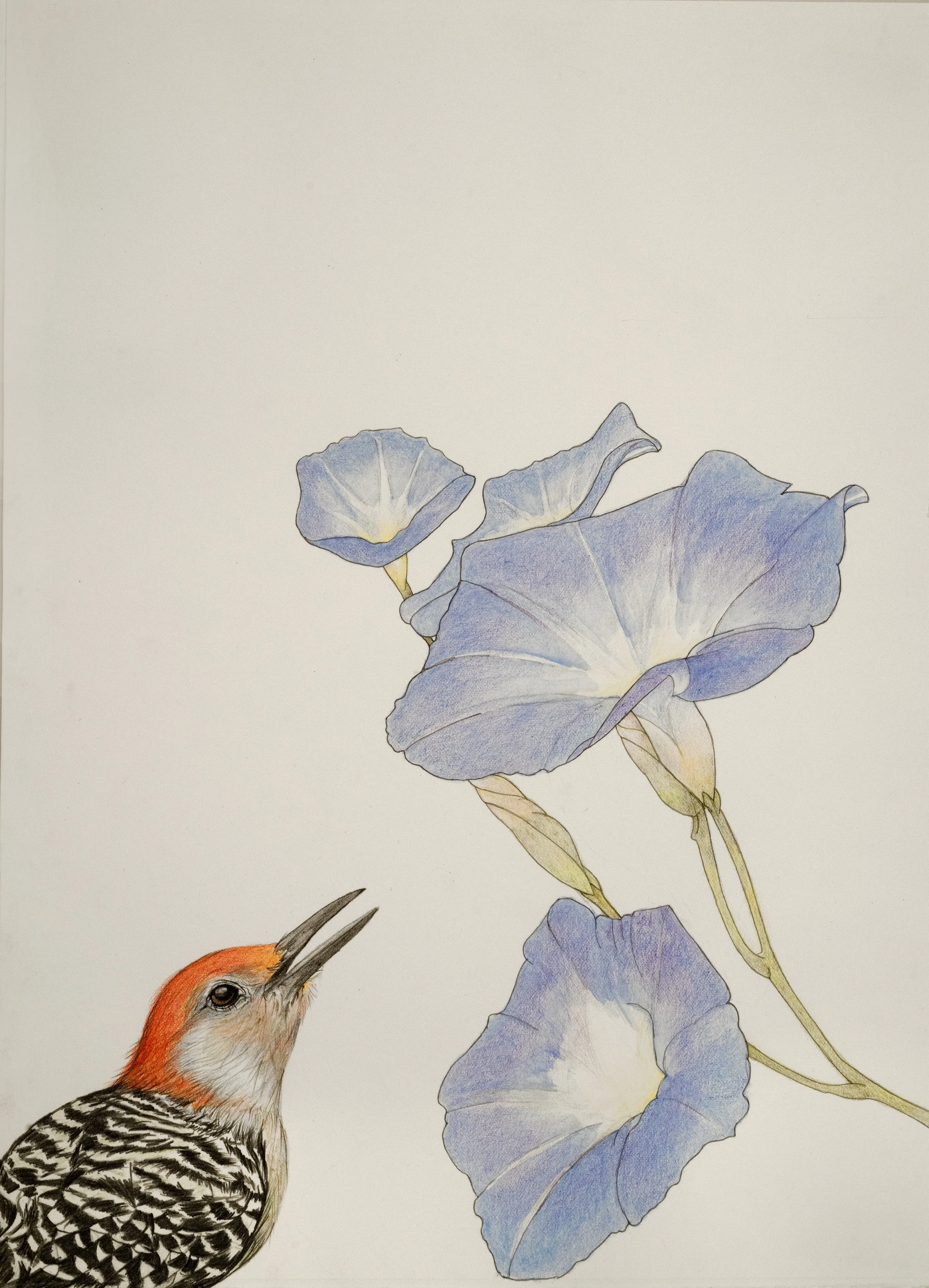
Woodpecker and Morning Glory by Rebecca Clark
The Arroyo Seco is a 24.9-mile seasonal river that moves water from the San Gabriel Mountains in the Angeles National Forest past NASA’s Jet Propulsion Laboratory through the cities of Pasadena, Altadena, La Canada Flintridge, South Pasadena, and Northeast Los Angeles. While most of the Arroyo Seco is heavily impacted by damming, channelization, freeway construction, and development, the span north of Devil’s Gate Dam tenuously retains its native vegetation.
The Gabrielino Trail meanders through this landscape of riparian stream zone habitat, riverside alluvial sage scrub, California buckwheat-laurel sumac scrub, coast live oak woodland, and white alder-California sycamore woodland. It is the only trail in Altadena that the Eaton Fire did not reach, flames coming within one mile.
The following is a collection of field notes taken on walks along the Gabrielino Trail in the upper Arroyo Seco wilderness from January 15, 2025, eight days after the fire began and sixteen days before it reached full containment, to the morning of Tuesday, May 21.
January 15
My first day back. The canyon is empty. There are no people strolling. There is no sound of water. There are no birds. They are somewhere of course, stunned, standing in the chaparral. Still, the alders, leafless. Like they were before the fire. But now, the wind has turned them on their sides, and I see their roots exposed, protruding from the riverbank. The root ball is shallow, with less depth than my fingertips to my shoulder. I shouldn’t be seeing this, their invisible parts, pointing to the sky.
Before the fire, I saw a little boy, right here, climbing this great erratic rock, crying, and his parents let him cry, but encouraged him. Then he made it to the top and was happy. C. said that’s how we should raise our child one day. And C. said how much he loved this spot, where the trail narrowed and the rock rose from the sand. Now, an alder blocks the passage. Its empty canopy rests on the rock like a pillow.
The white alder, Alnus rhombifolia, inhabits riverbanks and spreads both by seed and rhizome. Its seeds, bark, and leaves are all food sources for fauna. The western tiger swallowtail butterfly uses it as a host plant. The white alder also can fix nitrogen from the air. The bacterium in its roots moves the nitrogen into the soil and makes it accessible for the surrounding plants. This is why alders are easily able to colonize disturbed areas. They can grow where others cannot.
Further on, the trail widens and turns briefly to asphalt. Firefighting teams wait there, under the coast live oaks beneath the powerlines. There are alliterate crew names having to do with blazes and flames written across their trucks. The men do pushups on the ground, really, they do, hands bare. They laugh, grin at us. We nod. Do I thank them for this? It is all so much like a play of itself, in the quiet, with smoke still ribboning the air. C. takes his mask off like them. He says they must know what they’re doing.
We turn around when we see the fire retardant, MVP-FX, running down the ridgeline and draping the sycamores and the stones in fine, strawberry powder. Logistical symbols are painted on exposed rock faces. A language I am not privy to.
January 26
A small, wooden hut fitted into the hollow of an oak along the trail. The facade of finely carved wood shingles, cut to the spontaneity of the chasm. An octagonal window, with tiny panes of glass, above a wooden door on hinges, which opens onto a redwood deck, ornamented with four Cutie oranges and a miniature bag of leaves. I crouch down and peer through the window into a furnished living room with dark molding and aubergine walls, a coin-sized painting of a bristlecone pine tree, a staircase leading to the center of the tree where the view disappears. This place is a secret.
It is the first rain. The fire retardant remains. In it, lead, chromium, cadmium, arsenic.
January 29
The trail is closed. A yellow sign is posted at the entrance. I notice a security camera but cannot recall if it was there before or after the fire. C. and I enter, and recoil at the first person we see. “Hello, fellow law breakers.” An old man with his terrier recites the civil codes defending his right to travel. He stands on one side of the river, we are on the other, the water rushing between us, loudly, quoting the Constitution to make us feel less assuredly that something has been taken from us.
In the early 1800s, the area between Devil’s Gate Dam and the mouth of the Arroyo Seco Canyon was a hunting ground for big game and grizzly bears. The bears were taken alive to the plaza downtown where they were forced to fight bulls. Tim Brick, previous Director of The Arroyo Seco Foundation, writes, “From about 1780 to 1855 wild cats, mountain lions and bears were captured in Hahamongna by groups of expert horsemen, who would lasso the grizzlies by two legs, sometimes by all four, and lead or drive them into the city to be pitted against the wildest bull found on the vast ranges.”
February 9
Audio recording beginning at 11:50 am and lasting seven minutes, on the walk from Sterling Place down to the mouth of the canyon: black phoebe, Nuttall’s woodpecker, killdeer, yellow-rumped warbler, acorn woodpecker, California towhee, Bewick’s wren, spotted towhee, American robin, California thrasher, California scrub jay, California quail, bushtit.
February 13
When it rains it smells like smoke. The Arroyo has become a river tonight, taking banks in fervor, composing islands. There is soot in the water.
We have long tried to control the unabashed swelling of water. In 1920, the Devil’s Gate Dam was constructed. It was the first of the County’s Flood Control Dams. In 1941, The US Forest Service began construction of Brown Mountain Debris Dam, located four miles into the canyon. These dams restrict federally endangered Steelhead Trout from spawning in the cold waters upstream, with more intact habitat than that below the Brown Mountain Dam. Remnant concrete pads in the water add another layer of difficulty. They were once used for firefighting efforts but are no longer used for anything at all. Last year, there were four thousand rainbow trout living in the Upper Arroyo Seco below Brown Mountain Dam, trapped.
February 17
A sign at the entrance to my neighborhood cautions those who enter to do so at their own risk. Last night, hundreds of toad songs rose from infiltration ponds next to the trailhead, filled recently by the rainstorm. It was dusk and hard to see the trail as I walked along listening to their ribbets. I almost stepped on one. He startled me because he was great distance from the water. He pulled himself desperately forward, rubbing his belly against the dirt. It reminded me of a video I had recently seen of a seal who galumphed thirty miles inland in search of food. I considered bringing the toad back to the water but decided not to intervene. Perhaps he saw the sign on the way in.
The Arroyo Seco is critical habitat for the arroyo toad, another endangered species. Arroyo toads are extremely sensitive to water quality which, along with development, is a contributing factor to their decline. The toads located in drainage areas from Big Tujunga Creek to the Devil’s Gate Dam represent the only significant population remaining in the coastal foothills of the San Gabriel Mountains. In the dry season, they hibernate underground in sandy substrate for months at a time. The moisture in the soil keeps their skin from drying. When the water returns in winter, they appear like magic in the evenings to sing their mating songs, long and fast musical trills lasting ten seconds. When the mates find one another, the female will often carry the male on her back, up the riverbank, to breed.
The infiltration ponds are contentious. The debate, between the local water company who use the basins to infiltrate water that they have pumping rights to, and local environmental groups who advocate for restoring the alluvial sage scrub by allowing the water to percolate naturally, is essentially a debate about whether or not to let the water flow unhindered, a question my region has a fraught relationship with. The Raymond Basin Aquifer, the groundwater basin under the upper Arroyo Seco, is violently dropping from over-pumping, losing 250 feet of depth in the last 80 years.
For two months I lived, with the help of my friends, without water. This was the same time this winter that the infiltration ponds were full, and each night, that long and fast musical trill sang close to my footsteps.
February 22
After the rain, small ferns, Woodwardia fimbriata and Polystichum munitum, begin to appear in crevasses of the sandstone cliffs. Dudleya lanceolata too. I am concerned they will be poached. It is illegal to do so, but so is being here. I remember my right to travel, but even then I stand still.
February 25
Most evenings, a man sits at the first beach in his camp chair. He has two large service dogs, poodles, on either side. He usually contemplates the water in silence. This evening, he played Christian pop music out of a small boombox next to one of the dogs.
March 7
Another common duo is the man and his mother. The man walks ahead of her. There is some distance between us. We stare towards one another as the space closes. An awkward “hello” falls from my mouth like a crashing Jenga. His response is not altogether different. The mother did not look up then, and still never has. Perhaps it is my fault for believing our friendship could bud from a pithy greeting.
March 18
The Ceanothus bloom. I learn they smell of lilacs like the prairie smell where I’m from only now, when they bloom at the Arroyo, because the foliage is overhanging the trail and is inescapable. I duck my head and walk underneath. I breathe in so deeply that the dangling flowers get stuck in my nose. I notice the color starts a deeper blue than it ends.
March 20
There are teenagers everywhere. They must have intel that the adults are gone. They never appear in less than groups of four. They stand in wide circles at openings along the trail and gesture confidently at one another. I feel fear when I walk by them, and God forbid I have to part the circle.
March 22
Owls tonight: western screech and great horned. I saw two teenagers walk into the canyon with their sleeping bags as the sun set. I think of the night and its promise of sleep, or love, or nightmare, in repetition. Except now every night, even the innocent ones like this with the owls, return in memory to the evening when the wind toppled the neighbor’s basketball hoop and the power was out. And C. came home with seven scented candles from the grocery store. We did not use a single one. We saw fire roll down the mountain. C. filled a cooler with food and dragged it across the wood floor, leaving a serpentine scratch. We left and fell asleep on the floor in my company’s office to many flashing computer lights, and then everything was different when we awoke.
Owls are expert at hiding. The western screech can blend perfectly into the striated bark of an elder oak. They hide during the day and hunt birds, rodents and bunnies at night. The great horned can swallow a creature as large as a skunk. When I returned weeks later, there was an owl pellet, undigested and regurgitated animal material, next to the kitchen door.
March 28
Today, the man with his mother seemed annoyed at my impending approach. He raised his hand listlessly and spoke the sacred word with obligation. I, in turn, followed his lead and shouldered my reply with an air of annoyance. His mother, predictably, looked down on the exposed aggregate concrete, broken in places.
April 4
The trail has reopened. The closed sign is replaced with one that reads “One careless moment.” No predicate. And there is a drawing of three transmission towers. I am overjoyed and walk deeply into the canyon that day and find two spotted Humboldt lilies growing off the side of the trail. The stalks are plump, waiting to flower.
April 8
I met someone collecting mulefat. I tell him that mulefat is an excellent bioremediator, especially for extracting lead from the soil. He tells me he makes things from it. Another person, with his dog, named Heaven, sitting at the bank. He rescued her but said she is like Heaven because she saved him. Further on, two people skinny dipping.
April 12
Marah macrocarpa wraps around the poison oak that wraps around the base of the coast live oaks that passersby dodge as the path narrows and widens. You do not notice poison oak in the winter. Only in the spring do its leaves grow and turn glassy, and you realize it is draped across everything. At the brewery, later, a drunk man lifts his shirt and showed the waitress his stomach covered in welts.
Toxicodendron diversilobum is a post-fire early successional species. It is often used in landscape restoration projects, but due to the dermal effect it has on humans, rarely in the garden. It is a food source for black tailed deer, mule deer, California ground squirrels, western grey squirrels, and many birds who eat the berries and use the vining structure for shelter. Despite its habitat benefits, most who have poison oak in their gardens elect to remove it.
I was once affected by poison oak on a private estate in Summerland. I was jealous that one person could own so much land, a summer house, a creek. Then I moved to the Arroyo, a public garden. Poison oak grows everywhere; it is barely contained. Its leaves are crimson in the fall. The seasons, surprise. The value of owning land now feels less. I enjoy the presence of others, eyes turned down to the broken concrete in private thoughts. And there is the fact that water moves too rapidly to be owned anyway. The moment you grab a hold of it, it is already gone.
April 19
The wooden hut in the hollow of the oak was discovered. People leave offerings on the front porch. A handwritten note, I must confess, that I opened. Three keychains, small school photos, a pink seashell. The porch overflows. We leave parts of ourselves, what remains?
April 22
Crossing the street, the dapper pop of hooves. The frutero has returned. I saw a man on horseback buying a bowl of fruit from the vendor. The vendor reached up shakily to deliver the mangoes, pineapple, jicama, coconut, watermelon, shaken with Tajin. Before the fire he also sold tamales but said that business is no longer good enough. Last night, the carousel on the ridge was lit. While I looked up at it, my dog ate a grape left on the ground.
April 25
The Humboldt lilies continue to grow. They look like they will bloom any day.
April 27
The door was taken from the hut. You no longer have to get close to the ground to peer into the octagonal window that lets you see the painting of the bristlecone pine inside. Plastic keepsakes spill over the soil.
May 1
Another argument about lead dust in the house. I walk, upset, to check the lilies’ growth and avert my eyes at the bike jumps recently cut into the meadow. And there, the tallest lily, on the side of the trail, there is a gap where the stalk used to be. The rip is haggard, but fresh. It must have bloomed then. No chance to seed. There is one more lily left, nearby, not yet blooming. I wonder if, while I am at the office or in the shower or cooking dinner, if I will be able to feel the moment it, too, is torn.
May 5
The interior of the hut has been dismantled. The painting and furniture are gone. It is pulled at an unpleasant angle from the hollow of the tree, gutted. It reminds me of the days following the fire when looters came. I wanted to leave the doors unlocked for firefighters to enter if needed, but my landlord locked them when we weren’t there. A neighbor said he stood on his roof all night many nights shining a flashlight to the street when the power was out.
A landscape can be fire resistant or fire resilient. Resistance means that it can withstand fire, not changing. Resilience means that it can, once devastated, recreate itself anew. Some plants do this by resprouting at the base—plants like toyon, mountain mahogany, elderberry. Other plants cannot resprout after fire but have dormant seeds in the soil that require fire to germinate—plants such as Ceanothus and manzanita. Others, Artemisia californica, Chamise, Salvia, can do both.
May 21
Audio recording beginning at 6:09 am and lasting 16 minutes, on the walk from Sterling Place down to the mouth of the canyon: Bewick’s Wren, house finch, California towhee, blue grosbeak, lesser goldfinch, mourning dove, phainopepla, spotted towhee, acorn woodpecker, European starling, killdeer, common raven, western flycatcher, northern mockingbird, California scrub jay, house sparrow, bushtit.
May 24
The alder leaves are grown in, small green bells playing the denouement of spring. Even the alder with its roots exposed is ringing. Our climbing rock, no longer visible under the verdant canopy.
Danielle VonLehe
Danielle VonLehe is a writer and landscape designer from rural Washington State. Her writing and gardens have appeared in The Los Angeles Review of Books, Landscape Architecture Magazine, Landezine, Gardenista, and Architectural Digest. She currently works at Terremoto Landscape in Los Angeles, California.