fiction
SPRING 2026At the Beach Again
by WILEY SCHUBERT REED
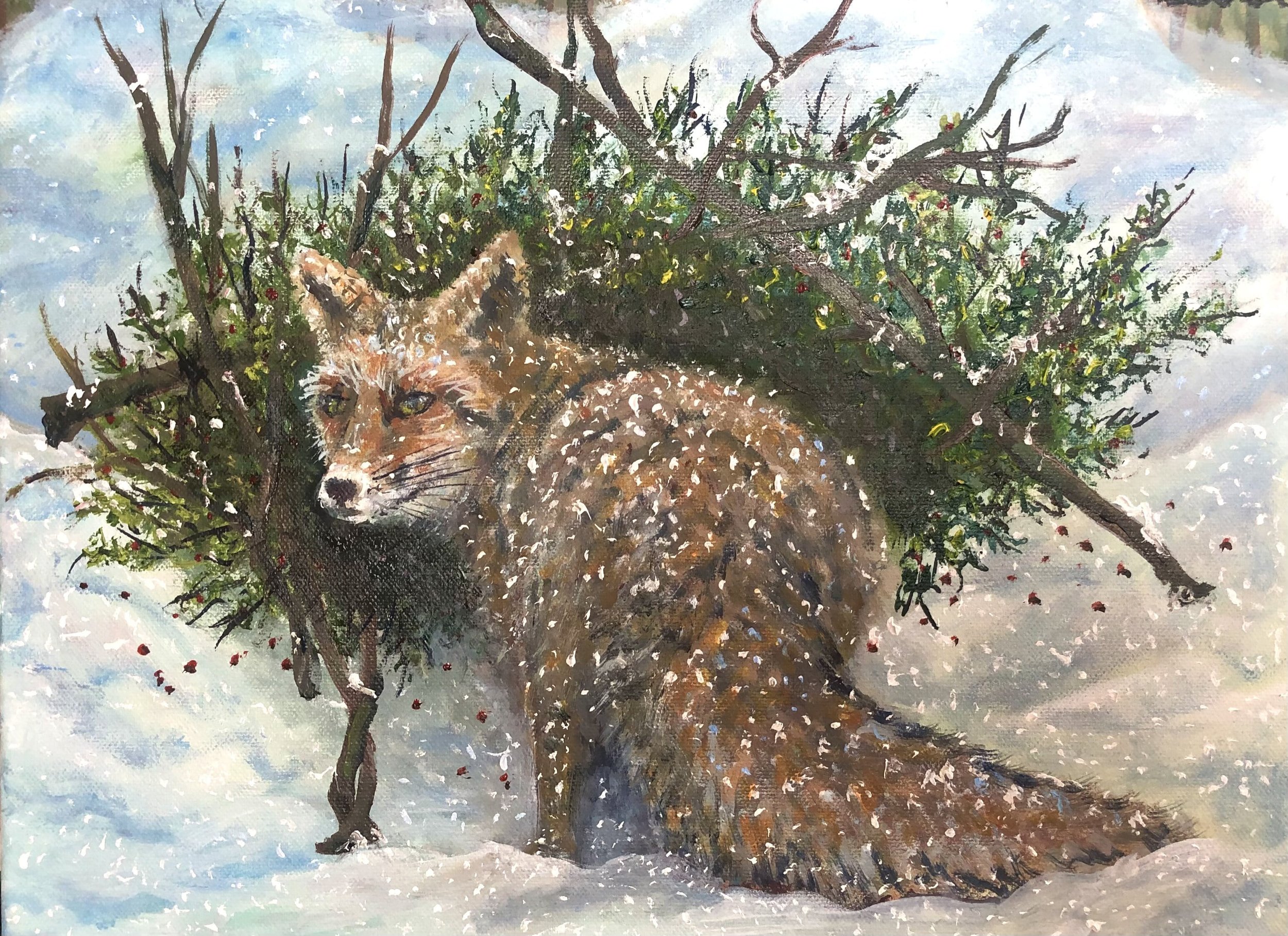
Untitled by Josephine Florens
He doesn’t look very dead, lying here half-thawed, the half remaining, the rest off and split among the coyotes. Still dad for certain, though. I guess for him, time has been somewhat of a nonfactor. Ice will do that.
Dad was right at the top, of course. He was one of the first to come out because he was one of the last to go in, before the ground got too hard and they just started burning the bodies.
Don’t quote me on this, but I’m pretty sure in high school, we learned about something called the rock record. There are eons and eras and periods and epochs and ages. All stacked one on top of the other, telling our story. Dig deep enough, and you’ll be in another age. Dig deeper, and you’ll be in another epoch or period. If you’re willing to dig, then dig.
One summer, decades ago, I remember we took a trip down what used to be the Grand Canyon, and after about five minutes of hiking, our guide told us that these rocks were 270 million years old. By the time we reached the bottom, we’d be hiking 1.75 billion years into the past. But now, all I can think about is that first layer of dust, drift of the Arizona desert. “There,” I could point to and say, “dad was alive.”
I look at him here, dead on the ground, and he looks at me. Same eyes, surely, beneath the thawing lids. Same half-smile bending through his lips. With that same stubble, same curly brown hair, still deciding when and how quickly it wants to turn gray.
“Hi, dad,” I say, and it feels good.
“Hi, son,” he says back. “You got old.”
I think I’m older now than he was then.
***
I aim to deal with the body the way everyone does it now. Mary stays inside because of the smell, which she hates. But then I have an idea, and I’m not proud of it, but I can’t help myself, him looking like he did right before he died, back when I looked up to him more than anything in the world.
I ask him if he is okay with it, and he says, “Sure, for a time.” So I get the axe, and I burn the body, but I keep his head, and I clean off the dirt, and I put it in a brown paper bag, and I tuck it in the basement freezer. Mary doesn’t go down there.
Outside, it keeps getting warmer, which I guess is a good thing. Except that dad hasn’t been the only one thawing out right below the ice, seeping into the ground, pouring straight into the aquifer.
Suddenly, we are at risk of drinking so-and-so’s mom or so-and-so’s ex-boyfriend or so-and-so’s once-newborn baby or so-and-so’s (or maybe even my) dad. Or the rats and squirrels and birds and cats and bugs and whoever––whatever––else is supposed to die and reenter the carbon cycle but didn’t when everything froze. Some people get really sick for a while. The National Guard has to intervene.
I start sneaking down to the basement at night to spend time with dad. After Mary goes to sleep, I’ll mutter something about a stomachache—the water, again—and shuffle out of bed and down the stairs and into a different epoch.
Dad has a lot to say, but he is also dead, so I do the talking for both of us. I tell him about Mary, who he’s never met. I tell him about the kids. He smiles and says, “That’s nice.” I know he can’t really care about this new life of mine. He is dead.
Mom outlived him, enough to see hell freeze over, but not long after that. He asks about Adam, who is still alive and kicking just fine. He asks about what happened to Anna. He says he thinks about us all a lot. About me and Anna. About our dog Margaret. About baseball, even—remember that? About everything that could have been but wasn’t.
***
Every time I come up from the basement, I feel a little less sure which world I’m supposed to be living in—this one or dad’s, which was also mine for a time. It’s kind of nostalgic, kind of something else. Like being homesick for a family home that’s been sold and whose residents have all died and whose furniture has been moved and whose walls have been repainted and whose floors have been redone.
It’s like that old paradox: if you replace every board on a ship one at a time until all the boards are new and none of the old boards are left, is it still the same ship? I’ve been puzzling on that one for a while.
One night, I say to dad in the basement, “I thought that in the frozen crust of the earth there wasn’t room for a boat to come undone from its mooring,” though I don’t say it quite that eloquently. He reminds me that giant glaciers will move mountains from one side of the planet to the other if you give them enough time. He always knows better, dad does.
“These last few decades have been an era in miniature,” I say, staring at the Tupperware of cranberry sauce from a few Christmases ago sitting next to him, freezer burn on them both. I make a mental note to throw it out. “Now, as this new Pleistocene melts away, I can’t help but cling to the fossil record it’s unveiled.” He smiles sympathetically as he watches me do this bad thing to myself.
***
The kids turn five and three, respectively, not on the same day, and I take Mary out to dinner for our tenth anniversary. She says I’ve been distant since the thawing, and I tell her I’ve been keeping my dad’s head in our basement freezer because I’m afraid to let go of the past. She tells me I have to get rid of him, and I tell her I will, but I don’t mention that I’m also keeping a lot more than dad’s head in that freezer. I tell Mary I love her and I’m sorry for keeping a secret, all of which is true. Two things can be true at once.
I dream most nights about the world before things froze over. Me and dad. Dad in full, not just as some severed head in my basement freezer. I meet him in a long-forgotten April trip to the zoo, hours spent staring at the bison, waiting for the snow leopard, sipping lemonade from the souvenir cup. I meet him at a family Thanksgiving, winks across the table, an inside joke secretly exchanged. And later, in an argument, stubborn, each of us, in our own strong-willed nature, to persevere. Invariably, the future makes itself known. On an arctic gust of wind blown in through a boarded-up window. On the cackling from the coyote pack still scavenging beyond the city line. On that icy drip, drip, drip, reverberating in the empty space of a story left unfinished. Lying in bed, it takes me a moment to figure out where I am, until I feel Mary’s warm body next to mine and another twenty years of life on my aging frame. I don’t think I can let go of the past. I am made up of it entirely.
I sneak down to the basement and confess to my dad something I’ve been feeling for a while now: “After you died, the world froze over and civilization splintered for a few years, and by the time everyone found their footing, I was still me, but everything and everyone around me had changed forever.” I flex my forearm, where an old scar has been bothering me these past few weeks, and dad watches, raising an eyebrow. “Without that continuity,” I go on, “I’m having a hard time accepting that this new world is any more real than the one I left behind.”
Dad thinks for a moment and then responds, “That explains the freezer. Hard to believe you’ve kept this thing plugged in all this time, given the circumstances.” I laugh. He’s too polite to say it, but I know I’m not making it easy on him, keeping him here. I grab the cranberry sauce before I climb the stairs.
***
They say on the news that the planet is healing now. That we’ve done enough good things recently to outweigh all the bad things we did before. I take them at their word, and Mary and I plan a trip to take the kids to see the beach for the first time. The beach as it once was and now is again.
I show them a picture of a shark on my phone, and I tell them that we might see one if we’re lucky. Mary reminds me that there are no more sharks. At least as she understands it, they’ve all died out. I’ve heard this, too, but I also think I learned in high school that sharks had already survived five mass extinctions before this one, and I like to believe that there are still a few live ones left if you look in the right places. Maybe that’s naive.
The beach is warm and windy and eerily similar to every beach I’ve ever been to, which feels wrong because everything else is different now. Mary takes the kids down the shore barefoot in the sand, their whoops of surprise at this new feeling carrying back to me on the wind. I dip my toes in the water, and I unmoor.
I imagine myself on a boat. Noah, bridger of gaps, preserver of what once was. I suppose it is the very boat I think of often now. Years pass as I look back from my perch to the shore. Young waves eat away at ancient sands. The land erodes, changes. Cliffs form, then tumble into new beaches. High school lovers sneak out onto moonlit dunes and tumble, too, leave impressions in the sand, erased with the next high tide or by marauding seagulls or nor’eastern gales. My ship also changes. My ark––one board at a time. I wish it wouldn’t but for the leaks and rot and biofouling. And what of all the old boards? Cast them into the sea? Let them wash ashore, scaffolding for the new beach? Let them debate for eternity?
One: “I was once that ship out there.”
Another: “I still am.”
A third: “I could be again.”
Suddenly, I feel a jab, the sharp point at the tip of an empty cone being thrust into my open palm. Mary and the kids have found a shell. I run my fingers along the cold spiral unfurling up and out of the creases in my hand. The lifeline is long, but for now, my feet are pruney, and my jeans are soaked.
***
I drive about a thousand miles with dad in the front seat in one of those Yeti coolers packed with ice, and we listen to his favorites, Steely Dan and Fleetwood Mac and an episode of Prairie Home Companion as we eat salt and vinegar chips. I pray we don’t get pulled over because I would have a heck of a lot of explaining to do. Dad asks, “Where are we going?” since he can’t see over the dash, and I say, “Home,” and that seems a satisfactory enough response.
As we cross into Illinois, he tells me about how the Cubs won the World Series in back-to-back years in 1907 and 1908 and then not again for over a hundred years. “A hundred years, can you believe it?” I tell him I can’t. “That’s a long time, Charlie. But when they finally won again, it was the happiest day of my life. Until I met your mom, of course. We celebrated in the streets.”
I work up the nerve and ask him, “How do you want me to do it?” and dad says to do it however we did it with mom. He’ll just be happy to be whole again. That, too, seems a satisfactory enough response, I think.
“I love you, dad,” I say, because there’s a certain reassurance in hearing the words out loud, maybe more for me than for him. He loves me, too.
It wasn’t all that long ago, maybe thirty years, that we drove to the hospital after a bad fall. Roles reversed then––talking, distracting from the obvious pain. And now, here it is again. A simple surgery, long since healed, but I still feel the scar. That phantom itch, bridging the gap, urging me on.
I know I’m running out of time now. I’ve been sitting on it for the last several hundred miles, and also maybe the last several years. “Dad?” I prod, genuinely, earnestly, not knowing, needing an answer. Dad says, “Yes?” and I ask the question.
“If you have a ship, and you replace every board on that ship one at a time until not a single one of the original boards remains, is it still the same ship?”
For a moment, we are still, dad and I, and the world rolls beneath us, intuitively. Rocky hills reacquainting their summits with the sun. Well-fed coyotes retreating to budding forests with their new young. Small midwestern towns stepping back into something eerily resembling life as they once knew it. Dad thinks, and I drive, and he doesn’t speak for a long while. I suppose it’s because he knows this is the last important thing he’s ever going to say to me.
“Yes and no,” he finally responds. “Two things can be true at once.”
Wiley Schubert Reed
Wiley Schubert Reed is a writer, musician, and theoretical physicist (theoretical because, despite studying it in college, he never became a physicist). He lives in Brooklyn, NY, and is currently writing a play about woolly mammoths. This is his first published work of fiction.
Quisque iaculis facilisis lacinia. Mauris euismod pellentesque tellus sit amet mollis.