
Nonfiction
SPRING 2026Birders of the Wounded World
by LEONARD YIP
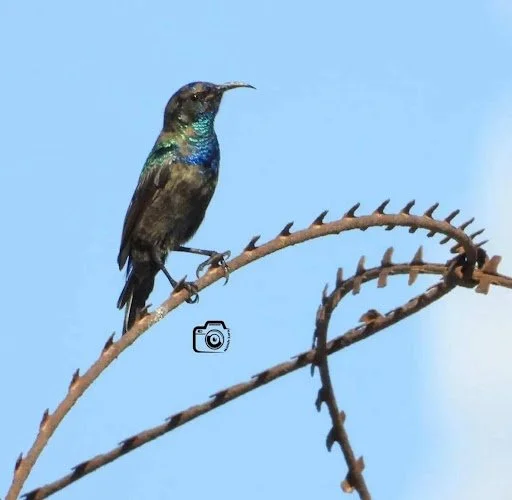
@sirdahtwins, 26 September 2024
It is the starkness of the image that pulls me in when I first see the photograph of the Palestine sunbird, perched before a blaze of sky upon coils of barbed wire.
Here, rust pitting the spikes that rake and bite at the air. There, the green of fields and the blue of deep glaciers, dappling the sunbird’s coat. This close, it is the wire that seems possessed by motion, writhing out of frame like a unquiet laceration. The sunbird, meanwhile, appears to be perfectly still—fittingly, for I learn later that the passerine is resident to the region. The national bird of Palestine remains resolutely in the wadis, vineyards, and orchards of the occupied territories; in the dry heat of the summer and the bitterness of the winter months, through the displacements, the bombardments, the griefs, and the calamities.
This photograph was captured by Lara and Mandy Sirdah (@sirdahtwins on Instagram), Palestinian birdwatchers whose volunteer work revolves around the documentation and conservation of birdlife in the Gaza strip. The journalist Marta Vidal records the moment of brightness in the eye which first fired the Sirdah twins’ love for birds. Drawn by the unique colouration of a sparrow they had noticed in their garden, the twins posted its photo online, where birders in the West Bank informed them that the bird was a Spanish Sparrow, just one of the hundreds of species whose migratory flight paths took them above the twenty five by seven mile strip.
Lara and Mandy grew sky-keen from there. Sight attenuated to plumage and pattern, and sensitivity deepened towards small beauties. Wherever the birds were, the Sirdah twins went, wading into wetland silt and peering over nests built out of shrapnel scars in the walls. They cultivated a patience in the seeing of birds, and the methods by which to do so. Birdwatching in Palestine faces particular, prohibitive challenges in acquiring the necessary equipment such as binoculars and cameras—beyond the cost, such tools are also considered by Israeli authorities to be hostile and dangerous.
For half a year, the twins endured rounds of questioning, as the camera they had gone to great lengths to acquire was intercepted at the border. Despite this, they grew fluent in the cartographies of passage etched in the sky above their heads, even as they themselves remained confined to Gaza, barred from leaving by the occupation.
From the Jordan Valley to the springs of Ein Qiniya and Gaza City, the skies across Palestine teem with birds. So too is the land filled with those who chase after them, and have made a life of loving them. The Sirdah twins began collaborating with Abel Fatah Rabou, a professor at the Islamic University of Gaza, working to compile a record of local birds—a taxonomy grown over the course of twenty years.
Amidst the grasses of Al-Mawasi and by the sea-bound rivers of Wadi Gaza, Rabou, the twins, and other volunteers trained their binoculars to the sky. They combed through taxidermied bird specimens in the dusty archives of the Biology Museum of Al-Azhar University. At the markets of the city they spoke to trappers and catalogued their stock, cage by cage, and by the Mediterranean coast they watched the hunters raise their great catch-nets and identified the fluttering shapes caught within.
Together, through this collective work of hands and eyes, the team published the first ever checklist of birds of the Gaza strip. The record identifies some 250 species of bird fauna, which represents almost half of the 551 species documented across the Palestinian territories. Impressively thorough, each bird on the list is given five ways by which it may be known: its family, its scientific name, its conservation status, its English name, and its local name in Arabic. In doing so, the record establishes not only data and classification, but also admits the ways by which people of the land have put a word to a song once heard, or syllables to a flash of colour at the corner of vision. These different kinds of noticing and naming constitute a kind of care, resilient in the face of war and scarcity. “The word happiness is not enough to describe what we feel, especially when we see a rare bird for the first time,” says Lara Sirdah. “The birds help us deal with the pressures of our daily lives. They make us forget everything.”
The twins were issued evacuation orders in November 2023, as the Netanyahu administration rained down bombs upon Gaza—the first of a city-killing tonnage that would come to level half of its houses, obliterate all its universities, and scorch more than eighty percent of the Strip’s farmland and tree cover by the time of writing. As Lara and Mandy fled towards Deir al-Balah, they were forced to leave their long-lens camera behind, the same one they had waited six months to finally receive. There are no institutions left in Gaza that provide support or funding for birdwatchers, and the Sirdah twins describe the pain of this loss to be as searing as that of displacement from their homes. Yet they continued their work resolutely. Using phones, binoculars, and whatever they could to track and observe, in the following months the twins recorded over thirty nine native and migratory bird species, uploading their photos to the Instagram account @sirdahtwins.
To read through their checklist, then, is also to parse a record that bears witness to the continual endurance of the birders of Palestine and their capacity for wonder. Each entry, every bird name, can be read as an individual reason to persist in a time of senseless cruelty, registering the world in spite of its continuing violences. The artist Ellen O’Grady depicts the late April afternoon when the Sirdah twins saw hundreds of storks circling about their heads. The hint of a smile plays across the faces of Lara and Mandy in the illustration, whose gazes have been drawn upwards. There, the wings of falcons and shorebirds sickle the blue gauze of sky in rushes of mid-flight motion, as the Sirdah twins’ words fill the top third of the panel:
God gave us a gift when massive flocks of birds of prey and white storks passed above us. We prayed to God that we can return north just like the birds. That we can return home when the war ends.
***
In Singapore, where I live, one of the region’s earliest published taxonomies of birds formed similarly as a survival skill born of love’s work, in days of occupation and massacre.
Rough foldmarks are still visible on the digitized pages of the Introduction to Malayan Birds, authored by one Guy Charles Madoc. Ink blurs over misspellings in the text, and its diagrams of wing anatomies have been visibly sketched out by hand. The lacunae and laconism of the book’s opening text hint, through omission and ambiguity, at the circumstances under which it was written: “First edition, May 1943. 1 Copy. Printed and published in Changi… Within these four walls so much interest has been displayed in Malayan birds that I have felt encouraged to write this book.” (emphases mine)
Madoc, a naturalist and ornithologist, wrote the Introduction to Malayan Birds while interred by the Imperial Japanese Army within Changi prison. When Singapore fell to the invading force in 1942, Madoc was detained along with some three thousand other civilians within a space first built to house only eight hundred. Hunger and disease dogged their steps in the thick, wet heat of the yearlong summer. They laboured in the bombed-out cities and roads beneath the burning day, clearing wreckage, filling low-lying swampland with dirt to build the occupation’s airstrips. Less than five kilometres away, the killing fields of the shorelines frothed with blood and oil as the Japanese began their ethnic cleansing of Chinese men.
In these conditions, under constant threat of beatings and deprivation, Madoc began his work of remarkable care, recollection, and defiance. The Introduction comprises forty-three categories of bird species, from cuckoos to barbets to orioles and babblers, with appendices recording the names of each one in Malay. Explanatory notes accompany each entry in the taxonomy, describing features by which the birds may be identified, as well as breeding seasons and habits. Yet there are also moments where the language of classification ruptures and gives way to Madoc’s interior griefs. Describing the cry of the Wattled Lapwing, he notes that its “clear, familiar call cannot fail to carry the perspiring observer straight back to some favourite, bleak upland of Home.”
We prayed to God that we can return north just like the birds. That we can return home when the war ends.
Having suffered the loss of most of his notes and books during the Fall of Singapore, Madoc wrote the Introduction almost entirely from his own recollection, between what he and other prisoners—the “Changi Ornithological Study Group”—could parse and draw out of memory. For them, too, the memory of birds was a way to survive the world’s woundings. Confined within the walls of the prison, they depended on the sight of the birds they could see and the remembrance of those they could not to stay alive. They were willing to risk their own lives to see the work completed.
In secret, Madoc and his collaborators smuggled, haggled, painted, wrote, and stitched the Introduction into being. They stole paper from the commandant’s office, and an artist identified as D.B. Molesworth provided coloured illustrations using what paint was left in his hidden watercolour set. Two French prisoners who had been bookbinders before the war helped to wrap the completed Introduction in leather, likely cut from the upholstery of a wrecked car. Madoc also managed to sneak a tiny folding monocular into the prison, barely large enough to exceed the size of three coins. This was a monumental risk. If such a device was found on him, he would have been tortured or killed by the Japanese on suspicion of espionage.
I think of Madoc and his collaborators pressed up against the prison wire: some of them on watch for prowling wardens, the rest crowding round and squinting through the monocle for the slightest glimpse of a wingbeat shearing the air. Then I think of Lara and Mandy Sirdah, chasing the path of the great drifting storks to the farthest ends of the border fences, cameras slung low to avoid the sight of Israeli soldiers. Each one sought reminders of the wider world beyond their barriers, but birding for them was also a subversion—an act of resistance, memory, and dedication, as the outwards and upwards gaze searched unceasingly past the walls and the wire to keep hope alive.
Madoc’s memory, and the descriptions he drew from it, was given to the animations and aliveness of birds. He describes migratory plovers exhausted from their journeys, and recalls the common sandpiper (“trigoides hypoleucus,” “kedidi") “running jerkingly over the shingle, or taking brief flights from boulder to boulder of some brawling hill-torrent”—a surging life still blazing in his memory. The common sandpiper (“زمار الرمل الشائع”) is a species also noted on the checklist of birds of Gaza, for the air above the strip forms part of the flyway that it—along with millions of other birds—takes in the autumn and spring months, tumbling down from the north to winter in warmer climes. This season is upon us now as I write. Sky-shoals of migratory birds are descending in the shadow of skyscrapers, upon breakwaters pulled back from the sea. They settle along the mangrove mudflats where the coast wraps eastwards, past the remnants of the prison where Madoc once sat.
I cannot help but imagine a moment of the birds slipping the borders of territory, memory, and time. As the sandpipers darted between the long draw of the tides, did the dark bead of one’s iris ever glance through the monocular lens to meet the eye of a watching Madoc? The sight would have seared into his mind such that he must have seemed like a man possessed, as he wrote his record of birds into the silent hours of the pre-dawn. The bird would have returned north to breed in the summers, and when the winds ran chill again, its fresh-fledged offspring would follow the same path south. So on, and so on: eight decades of winters and summers, wayfinding by the same ley lines and unseen impulses, until some distant descendent of that sandpiper might have danced across the heads of Lara and Mandy Sirdah like an apostrophe fractured from a word. I think of its eyes catching their own—eyes lit by a flood of wonder, as they walked the long road that led back from Deir al-Balah to what was left of home.
***
Lists and records of local flora and fauna are, however, also tied inextricably with the history of Palestine’s occupation.
The 1865 prospectus of the British Society of Palestine Exploration Fund proclaimed that “no country more urgently requires illustration” than Palestine, for “much would be gained by… bringing to light the remains of so many races and generations which must lie concealed under the accumulation of rubbish and ruins on which those villages stand.” The introduction to the missionary Hannah Zeller’s Wild Flowers of the Holy Land (1876) explained that “the chief interest of [its contents] will lie in the fact that they represent to us the very flowers on which our Lord’s eye must so often have rested in childhood.” The American reverend Harvey B. Greene’s Wild Flowers from Palestine (1899) pressed, between its pages, real flowers taken from the land, and prefaced the book with the following declaration: “Palestine is a land of ruins, but the flowers of its fields are as beautiful as when they were looked upon by the Master Himself.”
Bringing to light; our Lord’s eye; looked upon. So many of these early colonial taxonomies were obsessed with watching and seeing. But they privilege only a particular lens, one which is as concerned with occluding particular details as it is with sharpening others. This lens, observes the Palestinian lawyer and writer Raja Shehadeh, is “the prism of the biblical past,” which “overlooks present realities. Eager to occupy the land of their imagination they impose their vision and manipulate it to tally with that mythical image they hold in their head… which in the process has silenced Palestinian history and relegated it to prehistory, paving the way for the modern state of Israel to take control not only of the land but also of Palestinian time and space.” Such a lens saw Palestine as only rubbish and ruin, a brownfield to be settled upon and subordinated to the colonial imaginary. Today, lenses have evolved into instruments of routine violence as well as control—drone feeds, rifle scopes, surveillance imaging and targeting systems, all employed to watch, control, and murder.
The lenses of the birders of Palestine, however, restore what is perceived by the eye. “People are surprised when they see our photos,” contends Mandy Sirdah. “When they think about Gaza they think it’s only blockage, poverty, destruction. But there is also beauty.” The grid of the Sirdah twins’ Instagram profile is a riot of colour. Pale staves of egrets sway and silver the grass, a hoopoe’s russet crest unfurls as flicking flame… and, recurring always between the rows of photos, the bright, impossible iridescence of the Palestine sunbird beckons. Each photograph is a testament that speaks back against the Palestine imagined as rubble. They are works of counter-imaging and counter-imagining, firing the mind to a different kind of vision by pushing the region’s stunning biodiversity to the fore and casting light on the dynamic relationships between local communities and the more-than-human world they steward. Across the years it took to compile the checklist of Gazan birds, Rabou and the Sirdah twins also noticed a tenderness towards birds growing in the communities they worked with. “Now, there are even people who go to pet shops and markets to buy birds just to free them from their cages,” observes Rabou. “Because as a people under occupation, we shouldn’t put birds in cages.” To liberate another life even in the midst of one’s own entrapment is its own kind of gentleness, its own brand of strength.
Beyond what they depict, these photographs also reclaim who performs the act of seeing, and what such perception achieves. The aperture is wrested back from the domain of the occupying power; instead of being used to surveil, scry, and besiege, it is turned by Palestinians towards the work of observing, recording, and re-enchanting their world with wonder.
These acts of faithfulness continue to occur all throughout the occupied territories. In Gaza, the Sirdah twins return again to the sand dunes and the orchards and the great lakes where the waterfowl wade. In the West Bank, Mohammed Shuaibi and the birders of Ein Qiniya steal out into the early dark in search of the kestrels and swifts that flit through the olives, despite the risk of being shot by Israeli soldiers conducting operations at those hours. And on the banks of the Jordan Valley, Saed Shomaly skirts between Israeli settlements and military firing zones, gathering birdwatchers to tally the avian population of the area. Shuaibi stresses that “there are people who are interested in wildlife, even when nothing is available to them… there is life here, and we love life.” Shomaly declares that “if I die, I worked for Palestine—and I worked for the birds.”
With its rhythms of repetition, birding becomes an act of love and faith that is perhaps best described as devotion. Across the thousands of kilometres that span the migration paths, over the decades from one brutal regime to the next, the birders of the wounded world skirt death to pursue and preserve the more-than-human. They trust that there will be beauty each time they do so. They insist upon it, believing and searching and working to see it in the face of all the world’s breakings.
***
The rains have fallen upon the season of migrations here. They dust the pavements as a mist. They lash the trees and glass as a gale.
And yet, the skies thicken with minor miracles. Northwards from the site of Madoc’s imprisonment, a rhinoceros hornbill is seen again in the wetland reserves after two centuries of extirpation. For the first time since records began, nestled in the shrub cover of a grove that did not exist when the Introduction to Malayan Birds was written, a tiny rustic bunting is sighted and photographed.
A ceasefire is announced. A ceasefire is broken. Bombings kill a hundred and level buildings across Khan Younis and Rafah. Ninety-seven percent of Gaza’s animal wealth is bombed and starved to death; white phosphorus, burning pale in the atmosphere, sears air and song from the throats of migratory birds passing through the region. And yet, the Sirdah twins continue their work, releasing fresh sets of images captured in their displacement neighbourhood of Deir el-Balah, “a place that has become both a refuge and a reminder of resilience.”
When the rains break, I cycle down to the storm-drain near my home, which takes the squall’s whitewater brunt and runs it on to the sea. Water is pouring through drainage holes in the middle of the sheer concrete wall. What light there is at this drawn hour dances off the cascade like folds of silk; such a rippling, constant sheen, that a hard thing is made to seem strangely pliant.
Suddenly, a burst of parakeets breaks the pall of sky like a lightning bolt. Green on grey, chittering noisily, they are flushed from the forest canopy and chase northwards to drench the far fields in colour. For a while, I sit and watch, the birds wheeling one way and the clouds fuming the other. Then I head home in the fast-falling dark.
All along the way, streetlights hum like vesper candles. That evening, I see that the Sirdah twins have posted another picture. In it, a rose-ringed parakeet is perched on a thin branch. It tilts forward, weight pitched as if in readiness to take to the air, and its eye has turned to regard the viewer directly.
Below the image, for its caption, Lara and Mandy have written:
“The birds are flying again, and so are we.”
The Sirdah twins’ photographs of the birds of Gaza can be purchased as prints through making a donation at https://birdersofpalestine.com/pages/donations. All funds collected are transferred to Palestinian birders, to support their ongoing work.
Leonard Yip
Leonard Yip (he/him) is a writer of landscape, place, and people. He holds a BA and an MPhil in English from the University of Cambridge, where his work on multimedia representations of Singapore’s edgelands was awarded the Members’ English prize for best overall dissertation. His essays and poems have been published with Moxy Magazine, Ekstasis, and the Nature Society (Singapore). He lives and works in Singapore, with a continued focus on the changing terrains and ecologies of the Anthropocene.
Quisque iaculis facilisis lacinia. Mauris euismod pellentesque tellus sit amet mollis.