
Nonfiction
SPRING 2026Hungry Ancestors
by ARTI JAIN
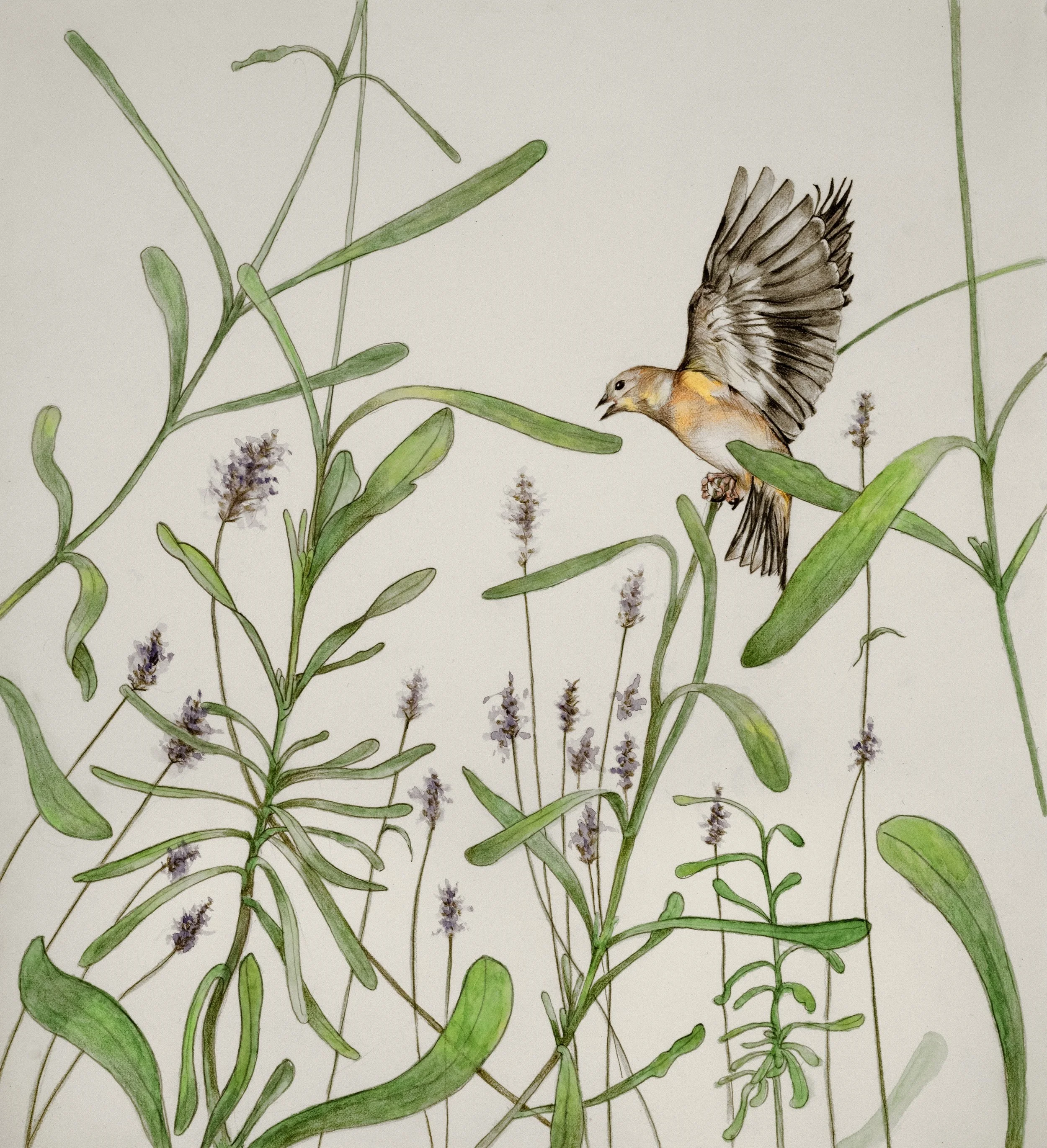
Goldfinches and Lavender (right panel) by Rebecca Clark
Every year, on the heels of monsoons, when the mountains are freshly washed and our valley is exuberant with green, the ancestors arrive.
Even before I open my eyes, my body wakes to my grandmother Beji’s cooking. At five years old, I’m more hers than Ma’s. Since dawn, Beji has been thickening milk over a low flame preparing kheer. I tumble out of bed. Saffron and cardamom nudge me to break Beji’s rule number one. Unwashed, I am not allowed to cross the threshold of her kitchen. Especially not today—the day she feeds the ancestors.
Ma and my aunt, bathed and bent over stoves and fires, without turning, shush me to go wash first. They follow Beji’s rules and recipes like tightrope walkers, lest the ancestors be wrathful. For when they arrive, nestled in the belly of our local priest, they must be appeased so they may protect our grains, not cloud our brains or drain away all the blessings fathers work so hard to gather.
I don’t go too far—plant myself in my favourite hiding spot, behind the guava tree that hems Beji’s kitchen. And wait. The priest arrives. Beji washes his feet. He stands like the statue of Rama, if Rama were fat. To me, he isn’t the vessel for the ancestors. He is the demon, Ravana, come to eat the kheer I’m dying to taste. The priest sits cross-legged on the kitchen floor, so his doughy, jelly-belly can rest on his white-dhoti draped knees.
Standing two feet away, I wonder exactly how many ancestors are inside him.
Then he reaches for the bowl of kheer, picks it up, holds it close to his chest. With his fingers, he scoops and shovels each morsel at top speed. His second bowl, he tips into his gullet like Father drinks whiskey. Bottoms up. I stick my arm out and make abracadabra circles to magic the priest to stop eating. But he’s already on his third helping, holding the bowl next to his laddoo-chin and smacking satiated ahas! after every finger-ful. He burps—Om Shanti. Ma brings him a bowl of warm water to wash his hands. From behind the trunk of the guava tree, I notice how clean his thick fingers are even before he plunges them into the brass bowl.
*
I’m twenty-five and the city, where I now live, has taught me how to hug. It’s the metropolitan way to shorten distances between strangers who pour out of valleys and mountains in search of work.
My aunt calls to check if I can take time off on Janmashtami. It’s raining when I arrive. The metal latch on the garden gate dings absent-mindedly. I let myself in. The guava tree I used to hide behind, climb to pluck fruit and sometimes jump from, has shrunk. So has Beji. She looks up and calls my mother’s name. No, no, it’s me, I raise my voice over the darkening storm outside. When Ma died six years ago, Beji kept saying it wasn’t fair—that it should have been her, not Ma. I bend down to hug her. But I stop mid-scoop. An acrid whiff of curdled milk makes my stomach turn. I’m not sure if I spot a louse scuttle through Beji’s matted mop of roughly chopped hair. Maybe it’s the low light. I drag my chair two feet away from Beji’s bed. Her eyes follow me. They remind me of the tin-coated, heavy bottomed brass vessels she used to scrub with wood ash late into the night. She would polish and wipe, polish and wipe till every pot and pateela was sun on the outside, filled with moonlight.
Dressed like a doll, in a single stitched cloth—nightie gown—clothes she never wore before, she adjusts an imaginary pure chiffon dupatta, trimmed with lace, when I get up to leave. She doesn’t put her hand on my head or kiss my hand. I pat her back. Her eyes are hungry. Walking away, I can’t decide if inheriting her recipes is the same as inheriting her dedication to feed those who have crossed over.
She won’t wash, my aunt complains when we are outside where the big mulberry used to be.
I miss it, I tell her, pointing to the spot where my childhood lived, under the shade of the mulberry. We need the space, more room, my aunt tells me.
*
Earlier this year, I turned fifty-four. Then September arrived and our mountains melted with the rains. Across continents, I watch Reels on Instagram in real time. Our valley floods, breaks bank upon bank, all known records. Our deodars and oaks, pines and sals float like corpses. The crickets don’t fill the hills with their soft trills. There is silence, except for the news that screams disaster.
A WhatsApp message interrupts my newsfeed, reminding me it’s that time of the year. Ancestors must be fed. Ma, Beji, Chacha—my favourite uncle— and even my baby brother have joined them. Calling their names now is like shouting into an abyss where forests used to be. They’ll be lost without landmarks like oaks, cedars, rivers, hills. I doom scroll for so long, the day ends. I switch on the kitchen lights and follow measures and steps from my yellowing Hawkins Pressure cooker recipe book.
Kheer
(serves four)
4 cups milk
6 tablespoons Basmati rice
½ cup sugar
2 green cardamoms crushed
8 almonds blanched and sliced
Add the rice, milk and sugar to the pressure cooker. Bring to boil on low heat with crushed cardamoms. Close cooker. Bring to full pressure on medium heat. Reduce heat to low and cook for 12 minutes. Remove cooker from heat. Allow to cool naturally. Open cooker. Add sliced almonds before serving.
I pour half the hot kheer into a pasta bowl, sprinkle warmth-soaked saffron and slivered almonds on top and carry it to my sitting room. Alone, without prayers and bells, incantations and gods, guilt and incense, I sit down, cross-legged to partake my inheritance on my favourite rug, a Sufra—the rugman had explained—a dining carpet of the Khwaja Roshnai, the people of the mountains in Afghanistan, woven by a mother for her daughter’s dowry. The flowers, phoenixes, pitchers and pots, vessels and vases and calligraphic verses in indigo and madder and stains made of tree barks and rinds of pomegranate hold me in their fold, coarse and smooth.
Arti Jain
Arti Jain is a poet, an award-winning spoken word artist and an author. Her most recent work is curated in The Indian Yearbook of Poetry 2024-2025, National Flash Flood Journal, Spellbinder Quarterly and is forthcoming in The Bare Bones Book of Speculative Fiction and The Amphibian. She lives in Doha and is at work on a memoir, for which she was named a 2026 HWR Khozem Merchant Non-fiction Fellow.
Website: https://arti-jain.com
Instagram: @arti.a.jain