
fiction
SPRING 2026Impact Study
by JUSTIN TAROLI
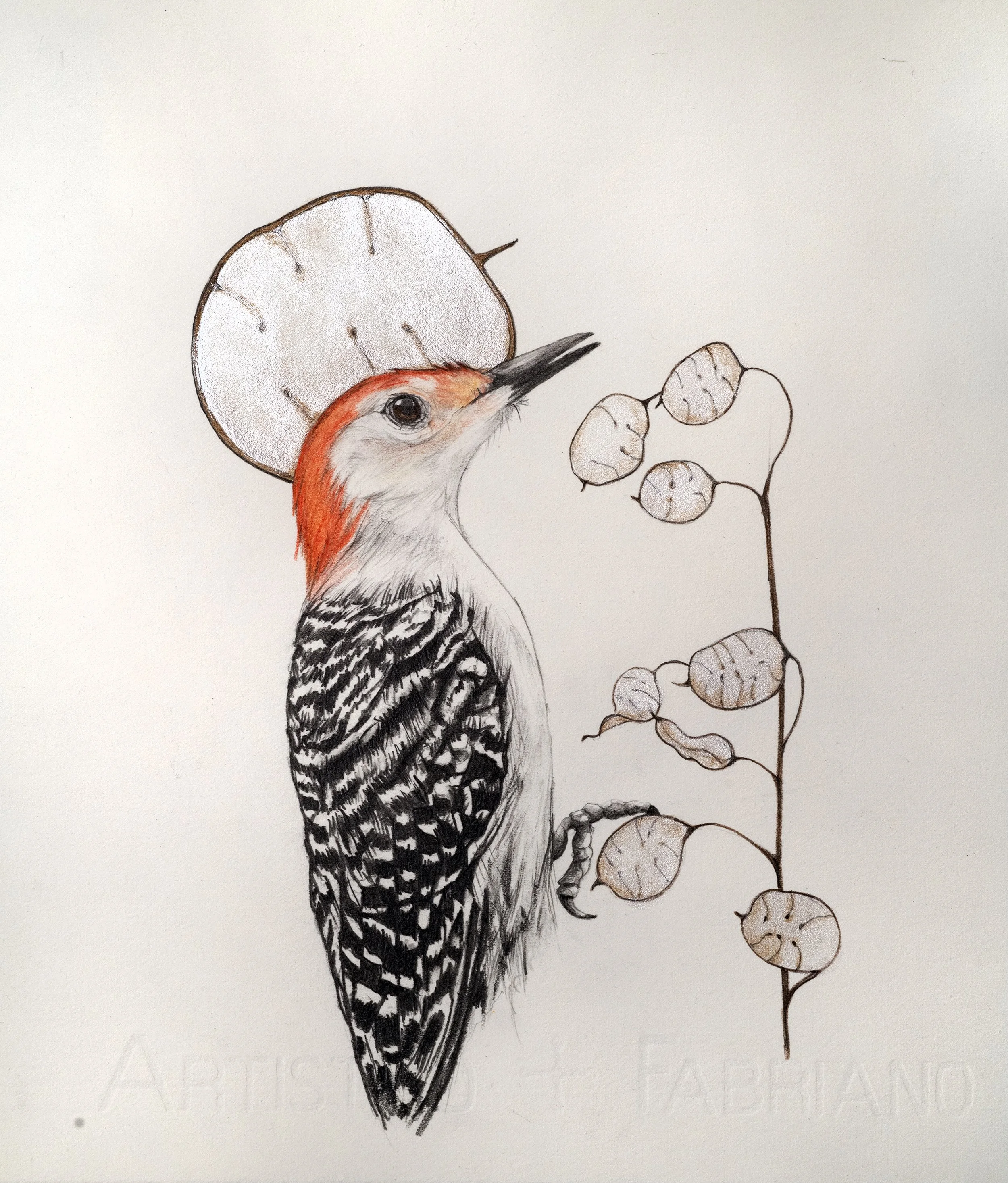
Woodpecker and Honesty with Winter Aura by Rebecca Clark
The deer had always known the roads. They had learned their seasons by them—the rush of salt trucks in winter, the smell of tar softening in July, the steady migration of human lights from morning to dusk. In the long years since the forest was carved into lanes and driveways, the herds had adjusted their crossings, altered the hour of their feeding, learned to wait for the quiet between engines. They were patient animals. They could afford patience.
In late autumn, when the air carried the taste of iron and the leaves fell like cooled embers, something in the rhythm changed. The cars did not slow anymore. They came faster, their beams whiter, their sound lower and meaner. The humans inside were half-asleep or angry, their thoughts elsewhere. The deer could smell the heat in the metal as it passed, the sweetness of exhaust, the faint pulse of the living behind glass.
At first, the deaths were ordinary. A young doe at mile marker twelve. A fawn near the bend by the diner. The kind of losses the woods absorbed without notice. But then the tracks began to tell a different story. The bodies lay not at the shoulders of the road but in the center of it, facing the oncoming lane, as if they had turned back. In one place, the mud showed a line of hooves charging downhill—not away from the highway but toward it.
The foxes were the first to notice. They found more meat than they could bury. Then the crows. Then the bears, bold enough to drag flesh under the guardrail before dawn. The balance of things had shifted, though no one yet understood in whose favor.
There was a night when, not far from the quarry, a buck stepped out beneath a moon still caught in cloud. He was old, his antlers polished down from years of sparring. He waited until the roar came. The headlights found him, and for a moment, the forest lit up like day. He did not run. He bent his knees and leapt, not up and away as instinct dictated, but straight toward the light.
When morning came, the humans called it another accident. They marked the blood with chalk, measured skid lines, filed reports. They would speak of rutting season, of blind panic, of creatures too stupid to understand. But the woods knew better. The scent on the wind was not of fear. It was of decision.
And so the pattern began again—quietly, as all new hungers begin.
The others learned by watching. They saw the way the buck’s body had landed, how the car had folded, the steam rising from the open hood. The herd returned to that place in the evenings, tracing the scent of metal and blood. The younger ones approached first, curious. They licked the road salt from the cracked asphalt, sniffed the fragments of glass glittering like frost. In their nostrils, the air held two kinds of death—one that lingered, one that moved.
It took only a few days for the lesson to settle. The next to leap was a yearling, thin and clumsy, but eager with the fever that came each autumn. The car was smaller, its driver slower, and the deer met it head-on. The humans said later that it had “thrown itself,” a phrase they used for despair, never hunger. They did not understand that the body could learn what the mind had not yet named.
Word traveled the way all forest messages travel: through scent and vibration, through the restlessness of night air. Along the ridges above the valley, herds began to gather at dusk in numbers not seen in years. They stood close together, their eyes catching starlight, their ears tilted toward the far hum of the highway. The noise was constant now, a low thunder that had replaced the river as the sound of life. Some of the oldest deer remembered a time before it. The young ones thought it was the voice of the earth itself.
Each evening, more of them came to watch. They waited in silence, learning the rhythm of headlights—the brief pause before the next set arrived, the change in pitch as engines crested the hill. They learned that humans drove alone more often than not. That the smell of coffee and alcohol clung to the interior of their cars. That certain stretches of road, slick with fallen leaves, gave way easily.
When one of their own fell, the herd did not flee. They stood at the edge of the woods until the noise ceased, until the flashing lights came and went. They saw how the humans covered the bodies, how they dragged them aside and left them to stiffen in the cold. It was not cruelty the deer felt then, but comprehension—the recognition of a pattern that could be followed in reverse.
In the early mornings, before the fog lifted, the first experiments began. A doe stepped from the tree line onto the shoulder and stood still as a post, forcing the car to swerve. Another followed hours later, misjudging her timing but learning all the same. From the ridge above, the herd watched. They were not a species of plans or maps, yet they possessed a kind of patience that mimicked strategy. Each attempt taught the next. Each death was a diagram.
By the time the first snow came, the tally of collisions had doubled. The newspapers in town printed warnings about migration patterns, mating seasons, climate changes. They did not print the truth, though the truth was simple enough: the deer had begun to hunt. They had found the shape of a weapon, and it was speed.
*
The humans began to notice in the only way they knew how—by counting. They tallied the dead along the highway, wrote letters to the paper, argued at town meetings about fencing. They spoke as though the problem had appeared overnight, as though the forest itself had not been listening all along. The hunters claimed the population had grown too bold. The drivers blamed the moon, the weather, the new construction that cut another corridor through the ridge. But no one asked what the deer had learned while they were busy explaining.
The deer watched them. They waited beyond the orange cones where men in vests scraped blood from asphalt, beyond the police cars parked with their lights still turning. They smelled the sweat of labor, the heat of engines idling. They saw how the humans’ eyes darted toward the trees but never long enough to see anything clearly. The deer understood this: humans could not look for more than a heartbeat without needing to name what they saw. To name was to believe the naming was enough.
As winter pressed in, the forest grew thin with sound. The rivers hardened at the edges, and the air tasted of road salt and ash. The deer moved lower in the valleys, closer to the houses where grass still showed. From porches, the humans saw them standing at the tree line, motionless and numerous, their breath rising like smoke. Some whispered that the animals had lost their fear. Others said they were starving.
But it was not only hunger that drew them. It was study. They learned the soft patterns of human motion—the routines of headlights leaving driveways, the way tires crunched snow, the brief delay before the turn onto the highway. They could sense vibrations through the pads of their hooves, reading them the way humans read the weather on their phones. The world had always spoken this way, through pressure and tone, through invisible tremors. The deer had remembered how to listen.
There was a nurse who drove the late shift, the same car each night, same time, same narrow bend. She had hit one of them in October, and the herd remembered the sound. They waited for her each morning, hidden in the fog, sensing the low hum of her approach. They did not hate her; the deer did not hate at all. They only followed the current of what had been learned. When her headlights appeared over the rise, the younger ones tensed, their bodies tuned to the geometry of impact. The forest seemed to hold its breath.
Far down the valley, an owl called, and the sound carried through the pines like a warning—or perhaps like applause.
The nurse’s name was Joan, though the forest did not know that word. To the deer, she was scent and pattern—a trace of antiseptic and fabric softener, a steady rhythm on the road each morning before dawn. Her car’s engine carried a particular timbre, a thin whine beneath the hum of its tires, and the herd learned it as they had learned the pitch of running water or the groan of frozen branches. She belonged to the map of their knowing.
On the morning it happened, the highway was still wet from the night’s rain, the white lines dim under the film of moisture. From the ridge, the herd descended early, their bodies dark against the lighter fog. They took their positions along the shoulder where the guardrail had bent weeks before—a relic from another attempt, another body.
The lead buck stepped onto the asphalt first. His coat carried the faint musk of rut and blood. He moved without hurry, pausing to test the air. Behind him, two younger deer followed, their ears twitching in unison. They could already sense the vibration of the car cresting the far hill, miles away yet, but closing in fast.
Joan’s headlights cut through the mist like twin spears. The deer did not flinch. They watched the light grow larger, brighter, until the night seemed to fold back on itself. When the sound reached them—the low, accelerating hum—they began to move with the rhythm of a practiced motion. The lead buck angled his body into the lane. The younger ones mirrored him. It was pattern recognition. The line between death and learning had worn thin.
Joan saw them too late. She had time only for the thought—again?—before her foot found the brake and the car began to lose its grip. The tires hissed over wet leaves. Her hands turned the wheel too sharply. The car swerved and caught the edge of the guardrail. The first impact came like a thunderclap. One deer, then another. Glass erupted inward. The horn blared without stopping.
The herd stood in the fog while the noise dwindled, their ears flicking at the faint ticking of cooling metal. Steam rose from the wreck, white against white. The lead buck lay in the middle of the road, one leg twisted, breath shallow. His eyes blinked once, twice, then stilled. Around him, the younger ones watched, waiting.
When the light from the oncoming traffic appeared—a distant pulse through the fog—the herd retreated to the trees. They lingered among the pines, listening to the human voices arrive: a shout, a radio crackle, the hollow slam of car doors. The nurse was alive. They could smell her blood, sharp and human, mixed with the copper scent of their own. The rescue lights turned the mist red and blue, red and blue, as though the forest itself were breathing.
The deer waited until the noise faded. Then they stepped back onto the road. They nosed the lead buck’s body, inhaled his scent, and learned from it. His muscles had tensed too early; his leap had been too high. The lesson was not lost. One of the younger ones pressed its muzzle to the warm patch of glass where Joan’s blood had smeared. It smelled of salt and heart.
By dawn, the wreck was gone. The road bore only faint black arcs and a scatter of fur. But the deer remembered the shapes, the distances, the moment of convergence. They carried it the way humans carried rumors—passed along, reinterpreted, never quite forgotten.
Far above the valley, the clouds thinned to reveal a pale morning sun. In its light, the highway shone like a silver vein cutting through the forest. And in the quiet that followed, the deer stood poised at its edge, waiting for the next sound of approach.
*
By late winter, the deer no longer tested themselves against the highway. They understood it. They had mapped its intervals of silence, the color of its light at different hours, the patterns of motion that preceded a crash. What began as instinct had become something more intentional, a form of practice.
The herd that wintered near the quarry numbered twenty-seven. They had survived the first storms by foraging close to the road, where the plows left drifts of salt for the hungry to lick. They watched the traffic from the dark, their bodies hidden behind the screen of skeletal birches. There was no more guessing now, no more trial and error. They could feel the coming of a car the way they felt the tremor of thunder, a pressure that gathered in the marrow before it could be heard.
It was near midnight when the next one came. A pickup, two men inside, the bed stacked with scrap metal. They had been drinking; the forest could smell it—yeast and smoke and the sour edge of laughter. The deer began to move even before the headlights appeared, their bodies fluid, certain. The lead doe took the center, followed by three yearlings. They formed a loose arc across the lane, low and still, eyes reflecting nothing.
The driver saw them at the last moment, shapes in the mist, too many to count. He turned the wheel, hard and late, and the pickup’s back end slid sideways on the ice. The metal in the bed shifted, weight lurching. The truck crossed both lanes, struck the guardrail, flipped. The sound rolled through the valley like a slow explosion—steel bending, glass raining down, the dull percussion of impact after impact.
When silence returned, the forest exhaled. Steam rose from the wreck like breath from an animal’s nostrils. The deer stepped forward cautiously, circled the overturned truck, studying its broken symmetry. The men inside were quiet now, their blood mingling with spilled fuel. To the deer, there was no difference between the scents—both were proof of what the world required.
One of the yearlings pressed its muzzle against the cooling metal, feeling the vibration fade. Another pawed at the snow, revealing a fragment of glass that caught the moonlight. They did not eat. They did not flee. They only looked, memorizing the shapes, the sounds, the way the earth felt beneath their hooves when the moment arrived.
No deer had fallen this time. The herd stood whole, unscathed, their eyes bright in the dark. They moved together back into the trees, slow and deliberate, their bodies fading one by one into the cover of pine. Behind them, the truck’s engine ticked as it cooled, a final heartbeat winding down.
*
By dawn, the snow had sealed most of what the night had done, smoothing tire marks and footprints alike. Only a single dark patch remained where the heat of the wreck had kept the ground from freezing. From the trees, a young doe stepped out, her breath silver in the cold. She lowered her head and licked the blood, slow and careful, tasting iron and salt and something older beneath them both. The forest stilled around her, as though listening. When she raised her muzzle, the light caught on her whiskers, red for an instant, before she turned and walked back into the pines, the silence folding shut behind her.
Justin Taroli
Justin Taroli is the author of two books, one novel, and one short story collection. He is currently at work on his first horror novel. He lives in Queens, New York.
Quisque iaculis facilisis lacinia. Mauris euismod pellentesque tellus sit amet mollis.