
Nonfiction
SPRING 2026Salt Lava Stones
by KRIS FRESONKE
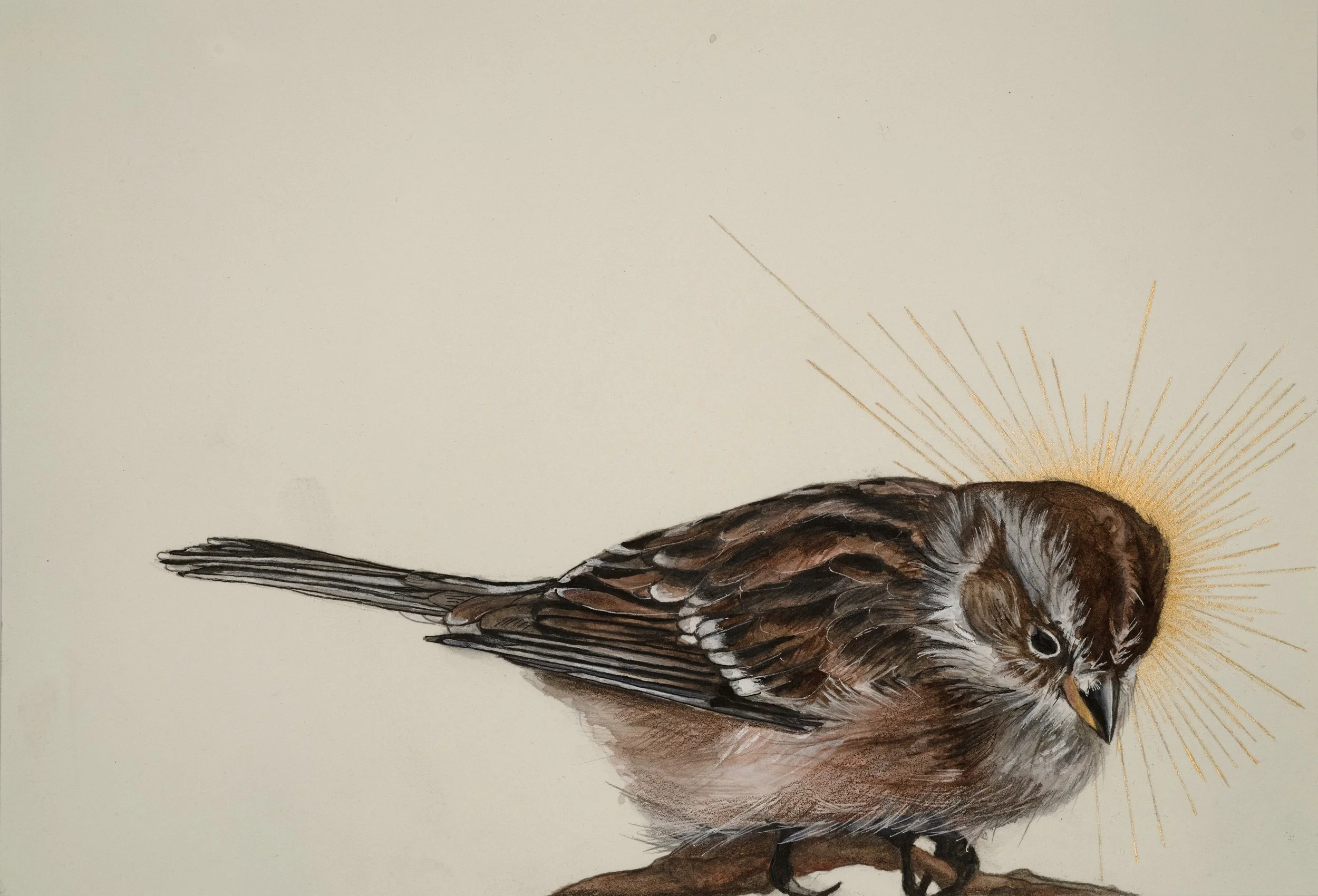
Sparrow with Aura by Rebecca Clark
We forget whenever we dig. In the layers of earth thrown about in Djibouti, in arid East Africa, ages of the planet rear up, buckled and pinnacled, like ruins of invisible cities. Old, old Jurassic: some 200 million years old, laid down in limestone here in Gondwana’s buried basement. The Cenozoic, all volcanism and rifting, the master builder of rhyolites and ignimbrites, spanning 66 million years, in frozen lava flows. After that, the Holocene epoch. Our time. A scant eleven thousand seven hundred years. The surface of Djibouti is mostly Holocene, that post-colonial geologic moment. The fledgling Holocene is 0.004 percent of all time and Djibouti is among Africa’s last countries to obtain independence. Its terrain is stubbornly juvenile. Some of its rocks got here just a few seconds ago. Djibouti was founded in 1977. A volcano last erupted here in 1978.
This shock of the new, young earth is too big for the imagination. Shallow time and tectonic terror: can we read meaning in landscape before geology annihilates us? Before extraction itself extracts our grasp, and slags it?
Djibouti discloses this story of ages, of deep time and shallow time, in at least three shrewd features. They strike the eye everywhere. In a desert, they feel like archaeology, like design. Those features are salt and lava and stones. I suspect they are all legible, and I have the weird hope of a reader, the rage to see cities in rocks, to feel myself not yet annihilated. Beauty, says Rilke: nothing but the beginning of terror.
*
The salt of the earth in Djibouti is fact. It exudes, says an erudite friend, from the dirt. It eats metal, it explodes concrete. It lacks beauty, it mocks human endeavor. My guide to Lake Assal explained: It is very lonely. Small, barren, hypersaline Djibouti, anchored in its only mineral.
Salt has a story. Viewing the salt at Lake Assal is a destination in Djibouti, marked with road signs, a pilgrimage from the capital. Getting there is a few hours’ drive that descends 500 feet to Africa’s lowest point. In Djibouti, every road to the salt has a story too. Leaving the capital, jolting along with tractor-trailers bound for Ethiopia, we run parallel to the unfinished highway donated by the IMF. But this old road, says my guide, was built by the French, and now he’s flooring it, with prisoner labor. Or, turning northwest, here is a road donated by the sultan. And then closer to the lake, the Chinese gave this road when they built the factory. At the rest stops before reaching Assal, we pause to appreciate distant canyons. In the parking lot, from the back of a truck, there’s a brisk trade in palm wine. The heat and sunlight are already relentless.
Everyone has suspicions about salt. Salt is never a tool of diplomacy. Control of the salt trade by Djibouti’s Afars caused perpetual clan squabbling over routes and prices. The Afars named the lake Assal, which means honey, their joke on a world of drought. Salt was not sacred, either, and it was traded sometimes for slaves.
Today for Afars, the suspicions are about what China is doing with salt. China built the Assal factory and the road in 2015, and since then the quiet extraction, Chinese officials have told locals, is for making bath salts. But Afars suspect, based on the laden trucks that leave the refinery each day, that something more precious is involved, possibly lithium. Afars are by reputation ungenerous in sharing their suspicions to strangers, like a caravan that does not declare its cargo, and it was unexpected to hear them say it to a passing traveler.
They told me that bulk salt sells for about fifty dollars a ton, but lithium carbonate is hundreds of times more valuable.
China is said to dominate global EV battery manufacturing and to control most of the world's lithium processing. The green transition runs on extraction. Gentle cosmetic misdirection can disguise it. About ten green-colored silos on a campus of several acres rise up in a low, flat landscape, hunkered on Assal’s western shore—the largest structure for miles, drawing out what locals see are massive quantities each year. No human activity was visible that day, and my guide was wary. He groped for a word and, with a tone of apology, declared the Chinese to be uncivil. An Afar himself, and a natural scientist of nations, he conceded that Afars are very naïve.
I asked him for a word about Americans, and he said, Extra large.
There was at Assal, as always in Djibouti, a deal going on. The palm wine. The lithium. Khat traded at our car window. The guide, pumping gas, gestured vaguely in the direction of a distant cove where the slave trade had operated until the French banned it in 1889. We were at a black-market gas station for discounted fuel, behind a disused café, the pump hidden by corrugated iron sheets rusting from salt air. You had to know it was there. The cove where enslaved persons were still sold to Yemen and Arabia at least as late as the 1950s is named the Gulf of the Demons. This is the land of caravans, once camels and now trucks, where goods move in terms of knowing and not knowing, everything on the verge of contraband, everything about taking and extracting, everything a currency. As I wrote things down with my pencil, the guide said to no one, not happily, She’s taking. A lot. Of notes. The taking is about salt. Salt, in the rite of exorcism, takes corruption out of you. As salt takes water out of a cucumber. It can suck us dry. There is an acute human terror in our cells’ awareness of osmosis, in the snowy crusts exuded from under our feet grabbing up at us, each man a pillar of evils we don’t easily expel.
The lake is not at all beautiful, and feels more or less incomprehensible, a pan of white salt twelve miles by four miles across with the salt layered 200 feet deep. The salt will never be used up, not even by the lithium trade. The quantity today may be millions of tons, and as more sea water seeps in and evaporates, more tons are added every year. A salt abyss should be old, but it formed only a sprightly ten thousand years ago, when a volcano called Ardoukoba (“fast-flowing”) erupted and closed the lake off from the sea.
I have been to other salt depths, a young one in Utah and the oldest one on earth at the Dead Sea. Djibouti’s salt lake could never be a promised land, like Utah. The Great Salt Lake is sprawling, preserved in Latter-Day-Saint myths of deliverance, its western flats used today for motor racing and wedding-day selfies. Djibouti’s salt lake is also more empty than the Dead Sea, that landscape of conflict and history and memory where my family and I took a silly picnic in our first weeks living in Jerusalem. Our fizzy white wine at that extremely low altitude lost all its bubbles, and our enthusiasm eventually fizzled too in that troubled geography. We were very naïve.
The salt at Assal is little written of. There are two sources, one seeing salt in passing, the other seeing salt as punishment. Francisco Alvares, a sixteenth-century Portuguese priest-explorer searching for Christian Africa, saw salt traded in blocks when he passed through Djibouti on his way to meet the Emperor of Ethiopia. Zealous to find an African kingdom ruled by the mythical Prester John, who in European legend had children baptized with fire instead of water, Alvares also happened to note how the price of salt went up as caravans approached the capital city. In 1841, a Victorian military engineer named William Cornwallis Harris barely survived a journey across Djibouti and wrote a three-volume ballast about the trip called The Highlands of Æthiopia. Bigoted up to his eyeballs, Harris blamed his troubles in salt country, the water shortages and the apocalyptic heat, on the natives. Quick to see a biblical type, he relied on Lot’s wife to make sense of his ordeal, but of course the salt in Assal does not rise up neatly in pillars. Harris, dehydrated nearly to death, looking inward in a mood of Old Testament self-pity, found Assal an evil place … no place of seed, or of figs, or of vines, or of pomegranates. Neither, he continues helpfully from the Book of Numbers, is there any water to drink.
We drove to the end of the Chinese road and parked at the lake. The flatness and whiteness had no qualities. It was a place of no habitation, void and drear. I was reminded that improbable fossils have been dug up from the lake, from before it became hypersaline, when vegetation positively swamped the waters here, when coral grew like trees. The salt seemed to suck up noise, too, and in the silence an Afar man stacked plastic sacks of salt, an action that rasped minerally, loudly. Having arrived after hours of driving, I waited for the lowest point in Africa to announce itself in the pressure on my ears, in a decreased heart rate, in a fog of thickened atmosphere, in electric noise in my blood. My register of symptoms remained blank. Across the water, a klaxon sounded from the factory. The Afar man asked me to buy his salt. I paid him for a small bag and he said he would use the money to buy water for his family to drink.
Lake Assal, when in due course it is re-swamped with waters flooding in from the east, will help break up the colliding and splitting plates where Djibouti is, and it will create a new ocean. Or rather, it will be the completion of an old one. This has happened before. Supercontinent Gondwana once split up in a Jurassic huff of rifting, waters pouring in east to west. Djibouti is where magma has its exaltation, and its interment.
From what I’ve tasted of desire
I hold with those who favor fire.
We drove back on the Chinese road which had collapsed in parts from a heavy rain that only occurs once a year.
*
There are competing stories. The lava comes next. Hard Lake Assal is a teardrop in a weird geologic demesne where three tectonic plates are pulling apart. It is at the Afar Junction, at the top of the East African Rift, that outsize fissure splitting the continent. The African, Arabian, and Somali (or Indian) plates chafe and dissent in Djibouti, a process the writer John McPhee once called the earth disassembling. I saw the cracks myself, at the end of an unmarked road. They smoked and radiated from the deep magma chamber under my feet, the crust of the planet thinning by a few millimeters every year.
Djibouti’s waters move from right to left, getting smaller like Russian dolls—the Indian Ocean, the Red Sea, the Gulf of Aden, the Gulf of Tadjoura and Lake Ghoubet with the tiny diabolical cove, and then Lake Assal choked off from the seas by that young volcanic ridge. The waters will deluge westward the more the land cracks and fractures. The flood myth will reawaken. The cracks will open like vaults. Deep time will come to the surface.
Awaiting deluge, lava in Djibouti is already different. It has atoms that conturbate the world as violently as the salt and the seas.
Vehemence is in its birth. With three tectonic plates rending apart, magma surges to the surface, nothing holding it down, with less time to linger and absorb the elements in the earth’s crust. The plates are tearing apart so forcefully that the liquid mantle beads up like blood from a pinprick. Fast-moving magma under broken crusts like Djibouti’s speeds past the earth’s silica on its way to the surface, and shrugs off most of that critical molecule. Silica, or silicon dioxide, or SiO2, makes up over half of the earth’s crust. Silica behaves like a rumor, thickening the plot of whatever flows into it. When magma surges up without bringing much silica into its mix, the lava is more fluid. Like fast-flowing Ardoukoba.
Picture the chemistry: a silicon atom bonds with four oxygen atoms to make a tetrahedron, a pyramid. Silicon is at the center and oxygen forms the four corners. This molecular shape and its negative charge are made for joinery. One pyramid can link to another pyramid by sharing one oxygen atom.
Djibouti’s basaltic lava, low on silica, has fewer of these building-block tetrahedra. Spread thinly, they don’t combine into strong chainmail the way lava does when it has lots of silica. Instead, between the silica pyramids in basaltic lava are other minerals like iron and magnesium. Eruptions in Djibouti are less explosive—think Hawaii, not Krakatoa—because the more permeable basalt lets gases escape more easily.
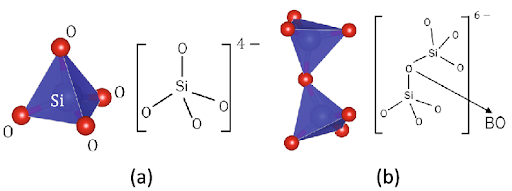
Silicon dioxide: (a) the molecule and (b) two molecules sharing one oxygen atom.
Source: Beidaghy Dizaji, Hossein & Zeng, Thomas & Hölzig, Hieronymus & Bauer, Jens & Kloess, Gert & Enke, Dirk. Fuel (September 2021) 307(1): 121768.
The lava’s appearance is ragged. In the wake of volcanoes are the vast fields of black basalt, broken roads of lava, terrible uptufts and marls, spatter cones, deformed kingdoms of rock. The salt lake itself drifts and dissolves, a Holocene transient, but insistent lava, which looks hard but is geologically runny, is the ultimatum of this cracking region called the Danakil Depression.
Lava like this devours its own cooling skin, in a cycle of flow, solidification, fracture, and reabsorption into the flow. The mood is self-negation, lava forgetting what it has just hardened into. Basaltic lava is also the amoral terrain for Djibouti’s long run of deals, in salt and slaves and now more salt, a flow with nodes of traders and connectors and agents, with pressures from east and west and from above and below, with the molten surges of wealth and power. Impassive as a ledger. Cooled lava where caravans rested, salt deposits at ancient shorelines where trucks trundle past. The rock a book of time, traffic, pressure, in the traders’ mining vocabulary of rift, fracture, eruption, annihilation. It rises in fault lines to surface, and sometimes to render itself void.
In the heat and desolation, it was hard to imagine being in this desert, much less wanting to be here. I tried and failed to picture myself in it, even while standing on hot fissures and sheets of lava that buckled like the roads we drove in on. I was unmoored from it, lacking all connective tissue. The afternoon heat is belligerent. Vanishing sweat leaves a sting of ultraviolet. While I’m in it, I know I am damned. I defy anyone to connect there. The Afars, who inhabit the place, move around constantly in search of water.
And a few seconds later was when my guide suddenly revealed to me his vision for the place. We were standing on that wide ridge dividing Lake Assal from the sea, our backs to the salt, facing eastward to the clear blue waters of the Gulf of Tadjoura that wash in from the Indian Ocean. Whale sharks migrate through there each winter. A few fishermen stood at the water’s edge. Without the deep alkali sink at our backs, we might be on a breezy coast in Greece, or Polynesia.
His plan is to build an eco-lodge at that blue water, on that coastline. He gestured broadly at the volcanic waste, conjuring tourism. Here, he said, reception. There, the bungalows. Over there, a restaurant, and down there a water-slide into the sea, for children. I squinted up into the sun. Black basalt. The shimmer of heat. The white torrid salt lurking a few miles behind us. He walked me to a new vista. As if I was simply standing in the wrong spot to see what he saw clearly. Stones and more stones and insistent cairns dotting every approach. Eco? Here? Where nothing lives and nothing grows and the salt explodes? A terrace where tourists watch the sunset while sipping ... what? Iced drinks in a place where refrigeration is a tiny flourish against volcanic annihilation? A business model of conservation and a small footprint where there is almost no environment against which to have an impact, where leaving a footprint might actually be a win against the void?
We stood there in the heat, staring at the same empty scene and seeing different things or seeing the same nothing and refusing to say. On our drive back he stopped to deliver khat to a village elder, a woman who could turn local feeling in favor of his eco-lodge, who could get things faster-flowing, who had been holding out. Another deal. I think she wants money, he said.
*
The human response to this waste and this quaking, explosive terrain, for the goatherds, for the caravans, for the Victorian explorers, for the clans and subclans who supplied salt and slaves to empires in Abyssinia and Arabia, has been: to stack stones. They are there in uncountable piles, mutely gathered up, verticals heaped over the dead. Or on a blood-soaked battlefield. Or at the gateway to lands won in war. Or a signpost of alliance. Or for a triumph over an enemy. Major Harris noted a hillside ornamented with many artificial piles marking the deeds of blood. Those are the reasons for stacked stones that we know about: woe to the conquered. The stacked stones are legion, in villages, at roadsides, by khat stands, with the neem trees, at derelict markets and huts.
I saw that other things in this weird landscape are stacked too. I began seeing heaps everywhere. Old tires piled up elegantly in a funnel. Bundles of khat in artful pyramids. A herd of white goats gathered on top of a blackened old kiln. All was stacked and arranged, made memorial. Stony monotony, tidied with cairns. Such antique seriousness marking out vast barrens. It might have been religion, or faith laid onto art, or art laid onto human mystery—but eventually, I began to see compulsion. It got on my nerves. When I closed my eyes, I saw them. When I reopened my eyes, I couldn’t decode them. When I stopped counting them, they multiplied. Each cairn was a universe, a still life. I fought intrusive thoughts about bloody deeds. I sped through the stages of confusion, annoyance, recognition, dissolution, and paranoia, all in a moment.
And then, flowing fast, the silicon dioxide in pyramids raised themselves up before my eyes. The molecules of the place, stackingly, cairningly, were saying it: how splendid in ashes, how pompous in the grave.
The unfinished work in this landscape was a collision of compulsions and driving forces. There was magma roiling up, wrecking the surface, shrouding with smoke and stones. Against this wreckage was the memorial, a stone that makes a death known and splendid, the reworking of a rockpile into a pillar, an intent, a declarative sentence. Maybe Djibouti was like other places, but the stacks seemed, as the shadows grew, particular to this place. Everyone who stays for long does it. The landscape infects with fragmentation. It was written I should be loyal to the nightmare of my choice. I was surrounded by psychiatric symptoms.
An anthropologist recently collected Afar riddles, and found this one: What little hill is decorated that causes distress to those who decorated it? Answer: An unavenged victim’s tomb.
And here is another riddle, this one from Antoine de Saint-Exupéry, who (before he wrote The Little Prince) flew the mail routes connecting the French colonies in 1920s Africa: “A rock pile ceases to be a rock pile the moment a single man contemplates it, bearing within him the image of a cathedral.”
I asked another Afar, feeling myself by then also a colonial messenger, why there were stacked stones. I pointed to a cairn and said, Why this? He wasn’t sure, and at length said une personne inconnue l'occupait: A person unknown occupied it.
These answers stacked up. They collided. They disassembled.
In late afternoon, when the sieging sun creates longer shadows, the stacks appeared from every angle, and traveling through the empty volcanic void dotted with infinite cairns felt maddening. The landscape’s desire to be unfinished, molten, and erupting warred with the human impulse to build. I became a bit deranged while attempting to tell built piles from chance heaps of stones that had tumbled into place. Those not-made mounds drew my eye for human ingenuity, for art, for cathedrals, and then wrecked it. If monotonous stone fields and expanses are hard on the mind, the prank of appearing to build was enraging. I was scouring perpetually for erased villages, for forgotten murders. As with the plates, I felt myself disassembling, my magma roiling, my new ocean forming. It is very lonely.
Sebald wrote that we are always looking and looking away at the same time. He would have been legless on annihilation. A pile of rocks in a place that is all rocks. Delicate and furious. Here the cairns number in the thousands. They occupy every terrain: basalt plains, cinder slopes, roadsides. Their heights vary from a few feet to seven. Some lean over and topple. Seismic stations record continuous microearthquakes. The Afar Depression widens measurably each year. The solfataras, the cracks that release steam, fume with carbon dioxide, sulfur dioxide, and hydrogen sulfide. The stacks remain where they were placed. New ones appear without announcement. No comprehensive survey exists.
Kris Fresonke
Kris Fresonke is a Seattle native, now residing in the UK after decades of living in India, Central Europe, Africa, and the Middle East. A former English professor, now an essayist on really melancholy landscapes, Kris is married with two children.
Quisque iaculis facilisis lacinia. Mauris euismod pellentesque tellus sit amet mollis.