
Nonfiction
SPRING 2026Witness at Witless Bay
by ALEXIS LATHEM
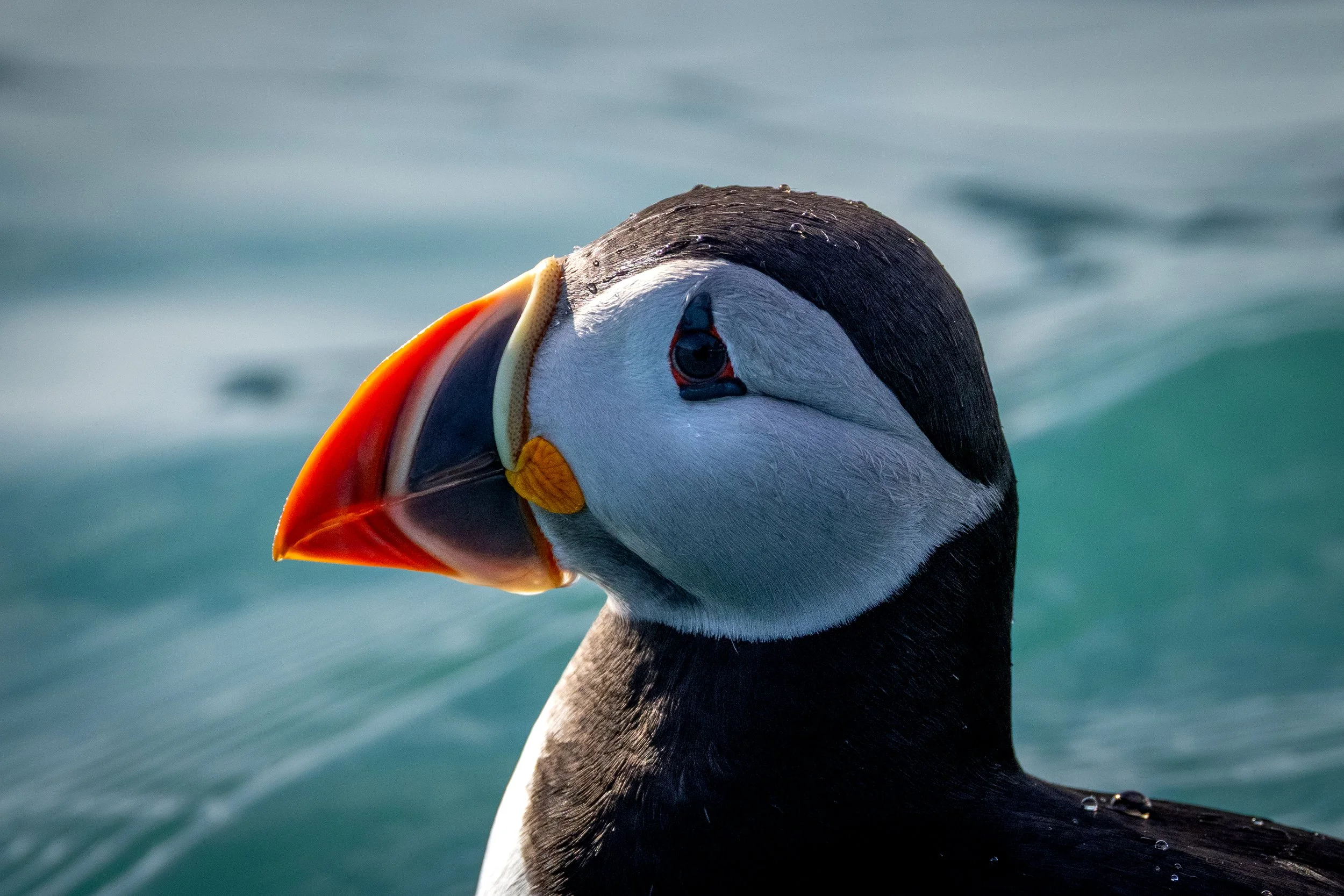
Portrait of the Puffin by George Eppig
I had long dreamed about seeing them. In their multitudes, in the grand setting of fog-draped sea cliffs. Because they throng in such immensities. Because they belong to the fog and the salt spray. Because they belong to the sea and yet they are winged, and yet they also belong to the sky.
I’d seen puffins before, diving through curtains of fog off the coast of Labrador. I’d taken the coastal ferry from Goose Bay to Nain, the northernmost stop on a journey that took a week. When the sky was clear we slept on the bow of the ship beneath the stars, and in the morning we watched a caravan of icebergs in the dawn light, rose-tinted and sun-licked like ice cream on a summer day.
The puffins had burst through the fog that enwrapped us, close enough that we could see their distinctive plump bellies squeezed into their comical penguin suits, their parrot-like orange bills and webbed feet. They bulleted past, speared into the mist, and vanished. On the return trip, I did not get to see them. We passed by the puffin islands early in the morning while I slept.
Maybe that is how they entered into my dreams.
Over the next twenty years, I heard the reports of their decline—of seabird wrecks and empty nests and diminishing counts across the world: puffins, guillemots, kittiwakes, razorbills, petrels, terns, albatrosses, penguins. On the Westman Islands in Iceland, the Serengeti of fish-eating birds, populations of twenty-three species—among them terns, gulls, kittiwakes, razorbills, fulmars, and half the world’s Atlantic puffins—are in a free-fall collapse.
And Newfoundland? I had read nothing about puffin population crashes there, and yet I worried.
The fog would have to lift if we were going to see anything at all that day. We were traveling by bicycle, staying at a B&B in Witless Bay near the ecological reserve on Newfoundland’s Avalon Peninsula where hundreds of thousands of puffins, murres, and kittiwakes nest in summer. My husband and I booked a tour with a wildlife guide. We were the only ones aboard besides our guide and the captain. Once upon a time I would never have paid to go on a wildlife tour, but otherwise there is no way to get out into the reserve, closed to all but the few licensed visitors. Our guide had a little dog who wore a vest that said, “Whale Sniffing Dog.” She was training him, our guide explained. “He can smell a whale before I can spot one.” This is a good place to see whales too, but the season for whale watching had already passed. We had come to see the birds.
We moved slowly into the Witless Bay Ecological Reserve toward the islands. The sea was moss green, reflecting the spruce and fir forests that fringed the coast and the islands. A mist hovered over the dark water and hemmed the base of the coal-dark cliffs, with the heights often disappearing into low-hanging clouds. On this day, the fog drifted away to reveal the crowns of the escarpments, where an eagle stood perched at the top of a prominent rock and surveyed the scene below. Another large predator, who also preys on puffin chicks, a great black-backed gull, watched too.
“There’s one,” said the guide, pointing to a small bird in dark plumage, still without an adult’s coloration, skittering across the surface of the water. Then another, wheeling and swooping overhead. Soon we were seeing them in great numbers, drawing silver trails over the water, swooning through the silence and the mist. This hush is how an inexpert eye can be sure these are not gulls, who would be shrieking and crying out loud. Puffins are quiet when they are at sea, though if you hold your ear to the opening of one of their burrows you might hear a muffled grunting noise. We passed under the shadow of a massive bluff and could see the terraces formed from their burrowing. The nests of kittiwakes and murres were nestled in the tufts of grasses and in the clefts between rock. There was not a square inch of ground that was not occupied. We drifted—or we moved so slowly it felt like we were drifting, parting curtains of mist as we entered the interior spaces, into clouds of birds in sashays, vortices of wings so innumerable it was like swimming through schools of sardines in their translucent ribboning. We were inside a living, spinning mystic cursive of ink and brush stroke with the key to its grammar and syntax guarded close. There was no horizon, there was no sky other than the mist. We circled around an island, passing a rock forming an arch, as if it were an effort at speech turned to stone, as if we were in a time before speech. We were no longer speaking, only listening to the whoosh of wings and the frantic slapping of wings on the water as the puffins launched their long running start before they took to the air.
“There—’’ Our guide gestured toward a great black-backed gull flying into the whirlwind of wings with a chick in his talons. We watched as the gull landed on the water and, with his back to us, devoured his prey.
Our guide was a young biologist from Germany who had taken a summer job here and fallen in love with the ocean, the whales and puffins. She has been here ever since. She spoke with a soft accent and had a melancholy air that seemed to blend into the mood of the scene.
I asked her how the puffin population was doing. “Populations haven’t crashed here like they have in Iceland.” There, the mackerel are filling the niche voided by the sandeels, she explained, but the newcomers do not fit into the serrated edge of a puffin’s bill and are too big for the chicks to swallow. “But here the population is stable, even increasing,” she said. “For now.”
For now. So much was packed into those two words.
There have been few times in my life when I have had the occasion to be in places without signs of a human presence. I mean, where you do not even feel a palpable absence of us, what lingers after we are gone, like a phantom pain, after loggers or miners or fishers have helped themselves and left the wreckage, where there were once fleets of ships or small vessels, where there was once an Indigenous presence. There are also those places, though, that have always belonged to wild creatures alone. “Magic arises,” writes ecologist Carl Safina in his beautiful book Voyage of the Turtle, “in the seamless meshing between the living thing and the setting that created it.” There is no other backdrop for these creatures other than these bluffs, these misty draperies, which are not even a backdrop because the birds are seamlessly woven into it. They are in the burrows, the loam, the clefts of rock and the paint splattering of their guano, in the waters smelling of lichen and eel breath. Though long by the standards of human time, their presence here is as new as the splitting of a continent to open this cleft of rock, this rift between sea and sky, still incomplete, where the land still quivers in the chill of the receding ice. Here, any distinguishing between the fowl of the air and the fish in the sea blurs. This is still a world without us, still holds all the possibilities of creation, still allows for another story that does not end in extinction.
Adult puffins, like anadromous fish, will return to the places where they were born and are loyal to their nesting sites year after year. Male and female will clean and prepare their burrow together, guard the nests, and feed their growing chicks. They will do a little courtship dance, clicking their beaks together, a puffin’s version of kissing. The iconic image presents the adult puffin with a clutch of sandeels for her chicks, draped from either side of her curved, enormous orange bill with its serrated edges, useful for holding onto her catch as she dives down for more.
After their parenting job is done, puffins will return to the sea, as will their offspring, who will spend three or four years on open water before returning to the same fold in the rock where they were born to raise chicks of their own. Year after year, the little puffin will live on the open ocean, through winter storms, bobbing like a cork on the surface of the swells. At sea, they live solitary lives, but beyond that we know little about their time on the open oceans. It is not easy to spot a single bird, a little larger than a robin, out there in the North Atlantic. They will use paddle-shaped feet to swim underwater and wings that have evolved to function as paddles and less effectively as wings. They stay turned into the wind, even when they are asleep.
It always seems like they will never make it, but then they take to the air. They are rather hilarious, and yet puffins, like other seabirds, lead heroic lives. Consider the Arctic tern who migrates farther than any other animal—from the Arctic to Antarctica and back. Who travel to Antarctica in winter. It is so unlikely that such a tender-boned creature could be so tough—the greatest traveler, the greatest survivor, as if survival were easy. Puffins are not great travelers like Arctic terns, but nevertheless they do clock the miles. One geo-tagged puffin tracked seven thousand miles over a single winter. The last of the dinosaurs turns out to be among the most diminutive of creatures: I can hold a puffin in the palm of my hand. Like seals, river otters, and sea turtles, puffins have need of land only in order to breed, and even then, they will return to the sea at night to roost on open water.
When John James Audubon was here, he recorded swarms of terns, gannets, kittiwakes. He saw loons, geese, larks, cormorants, gyrfalcons, eagles. He saw puffins in great numbers every day. He might have passed the same puffin island in a fog that I passed by all those years ago. The same burst of life emerging out of the gloaming in a conflagration of wings.
About the birds of this coast, Audubon wrote,
That the Creators should have commanded millions of delicate, diminutive, tender creatures to cross immense spaces of country to all appearance a thousand times more congenial to them than this, to cause them to people, as it were, this desolate land for a time, to enliven it by the songs of the sweet feathered musicians for two months at most, and by the same command induce them to abandon it almost as suddenly, is as wonderful as it is beautiful.
Though I have come to appreciate the warp and weft of a human presence into the fabric of more-than-human life, in a world dominated by us, I long for the company of other kinds, to be in places where humans have left no discernible trace. Though there is no place that has not been imprinted with radionuclides, chemical cocktails, and disruptions to the nitrogen and carbon cycles industrialism has unleashed. Nature, in this sense, was declared over a long time ago. Perhaps, to heal my species loneliness, I need to turn it inside out like an animal slipping out of her winter coat—to be inside a great multitude of the winged and feathered. To slip inside the foggy hollow of human absence as I would a curtained room, a place where I must remove my shoes before stepping inside, where I must speak in a whisper, or make no sound at all.
This is such a place.
And yet here I was, a human intruder. I left a chemical trail, and the sputter of a diesel engine followed as I passed through. I knew that this need was a selfish one—to have wild places all to myself—and that by my presence I was cancelling out the very absence of us I had come for. But tourism—of the right kind, accompanied by a guide who is both interpreter and protector—I now understand to be among the most effective tools of conservation. If there are places where humans are absent, it is only because a line has been drawn around them to exclude us, to keep us tethered and restrained.
And yet the winged multitudes did not seem to take notice of us. I almost felt myself invisible. “It is our task,” Rilke wrote, “to imprint this temporary, perishable earth into ourselves so deeply, so painfully and passionately, that its essence can rise again ‘invisibly’ inside of us.” Here in the gap of the for now, in the twilight hour of the vanishing, in the space of the not yet, Rilke’s words become for us an urgent instruction.
Solastalgia feels to me too soft a word. A sibilant word for a longing for what’s been lost that simmers beneath the surface. It does not boil over. It does not break us. In its original sense, the word nostalgia referred to a soldier’s homesickness even after he returned, so transformed by trauma that he still felt the sickness for home. Nostos meaning return home and algos meaning pain—there was nothing in this word about solace. But then nostalgia came to signify an escapist, comforting feeling, an imagining of a past that never existed. And so solastalgia, meaning the feeling of homesickness while still at home; meaning the sorrow we feel over ecological loss. The word does not suggest the pain, even the devastation, of coming upon an island strewn with dead chicks, at finding a coral reef, once resplendent and dazzling, bleached white as desert bones. It does not suggest the pain felt by Indigenous peoples as they experience the loss of their world while also having to bear an anticipatory grief, knowing that more loss will come. This “is a slow and cumulative grief without end,” says Ashlee Consolo, author of Mourning Nature. I prefer to call it—for this is the word that guts us, that contains the whole gamut of rage and denial and hurt—this unmitigable, disfiguring, and anticipatory pain at seeing the wings of the world disappear without the promise of return—simply, grief.
I often hear, it is not the planet that is dying; it is the human species, it is our civilization that is at stake. But what about the kittiwakes and the terns? The sea turtles tangled in nets, the monarch butterflies who can no longer make their epic journey? The planet will keep on turning; the rocks, the rats, the knotweed, the slime will likely survive, but the web of life, the diaphanous sheathe that wraps around this ball of rock and fire, the evolutionary processes that have given us puffins and monarch butterflies and the vampire squid and the ichneumons wasp, are what’s at stake. I can accept the idea of a planet without us. What I cannot accept is all the suffering, human and more than human, between now and then.
It surprised me that none of the other tourists I met at the B&B in Witless Bay where we shared a breakfast table had gone out to see the puffins. To me this was the great privilege of a lifetime—to see a spectacle of wings like that. To leave the human world and its ills altogether for a few hours and to enter another through a portal of fog. This was fledgling season, when the puffin patrols are active—volunteers who go around searching for orphaned chicks who have lost their way, though I didn’t yet know about these patrols, or I would have signed up. Like the sea turtle hatchlings, the fledglings will emerge from their nests in the night when they are protected from predators, using the sea-light to navigate towards the open sea from their burrows. And like the turtle hatchlings, the artificial lights from shores will confuse their sense of direction, and many puffins and other seabird fledglings will end up dead on roadsides. Communities around the Witless Bay Reserve have formed puffin patrols to gather up these lost chicks and return them to the sea. I find hope in this, as I do in the story of the sea turtle, whose populations are in recovery all over the Caribbean and western Atlantic. Turtle Exclusion Devices (TEDs) on shrimpers actually work, saving countless turtles, and the poaching of eggs is down to almost none. Property owners in homes and hotels on nesting beaches have agreed to turn off their lights during nesting season, in a spirit of cooperation that shouldn’t surprise me but does. In Mexico, Florida, Costa Rica, and Trinidad, volunteers queue up to go out in the middle of the night to protect the hatchlings as they emerge and begin their perilous journeys across the sand. We do this for salamanders, too, in my own New England town—during their migrations we help them to cross the road safely.
Puffin patrols on the Avalon are saving hundreds of chicks. But the changes to the marine food chain due to climate change are threats on a scale that leave us humbled rather than empowered. We know what we must do, though we don’t know how to do it, not without withholding acts of love and care (because how do we engage with the world without using technologies that cause harm?); though we don’t have the courage, though it all feels too immense. We cannot turn back the clock on a delayed warming set on time release. I have also tended to the dying when, as the sand pours through the narrow aperture of the hourglass of a single life, every sip of water, every small utterance, every drip of morphine matters as much as the greatest achievements of a life. We hold the dignity of a life in our hands like it were water we don’t dare let fall. Every lost chick. Every hatchling dragging itself across the sand. Our ecological grief must admit our rage, our denial, and our attempts to negotiate with just how much loss we can take. But acceptance it cannot admit.
Still, even in Iceland, where they are not raising chicks, adult puffins and terns are wheeling and diving through the air in their great multitudes. And so it is possible to imagine that life continues in its feathered magnificence. These are long-lived birds, and their wings still brush the air with their mysterious calligraphy. They will surround you in a blizzard of white wings like a snow squall. But in the crevices of rocks, in their deep loamy burrows, their chicks should be humming in their nests, slurping down the sandeels their parents bring them, growing fast until they are ready to wriggle free. But the sandeels do not come, and the chicks do not live to take to the sea. After so many failures, some seabirds have chosen not to build nests at all. They spend their years wheeling and soaring through the air in their solitude, in elegiac grace. Go to Iceland and you will find abundance—but as the adults die off and they are not replenished by the next generation and the next, that plenty will diminish and fade away like spring snowmelt. To this desolate land, those millions will not return.
But here in Witless Bay, a chill Labrador current draws down the sandeels, and the puffins are safely raising their broods. After our time among them, we pulled back and headed toward shore as the winged multitudes receded from sight. If we had torn a hole in the container of their solitude, we now let it reseal itself behind us. I stepped off the vessel, still feeling the need to speak in a whisper, to take off my shoes and tread softly.
We walk back along the East Coast Trail and then get on our bicycles. I hold my breath in the for now. I hold an invisibility in my cupped hands, careful not to let it slip, as if this were the hallowed place where life begins, the whole feathered, unfathomable world of possibility that can never die.
Alexis Lathem
Alexis Lathem is the author of Lambs in Winter: Sketches of a Vermont Life through Seasons of Change (University of Massachusetts Press), the poetry collection Alphabet of Bones (Wind Ridge), and two chapbooks. Her work has been supported by the National Endowment for the Arts, the Black Earth Institute, the 2025 Michael Steinberg Nonfiction Prize, the Chelsea Award for Poetry, the Bread Loaf Writer's Conference, the Marble House Project, the Vermont Arts Council, and elsewhere. Her poems and essays have appeared in About Place Journal, AWP Writer’s Chronicle, Beloit Poetry Journal, Chelsea Review, Gettysburg Review, The Hopper, Hunger Mountain, Saranac Review, Solstice, Spoon River, Tikkun, West Branch, and other journals. She received an MFA in Writing from Vermont College of Fine Arts and lives on a homestead in the Winooski River Valley in Vermont, ancestral land of the Abenaki.