Nonfiction
FALL 2026Somewhere in the Pryor Mountains, Montana
by SYLVIA SCIANNA
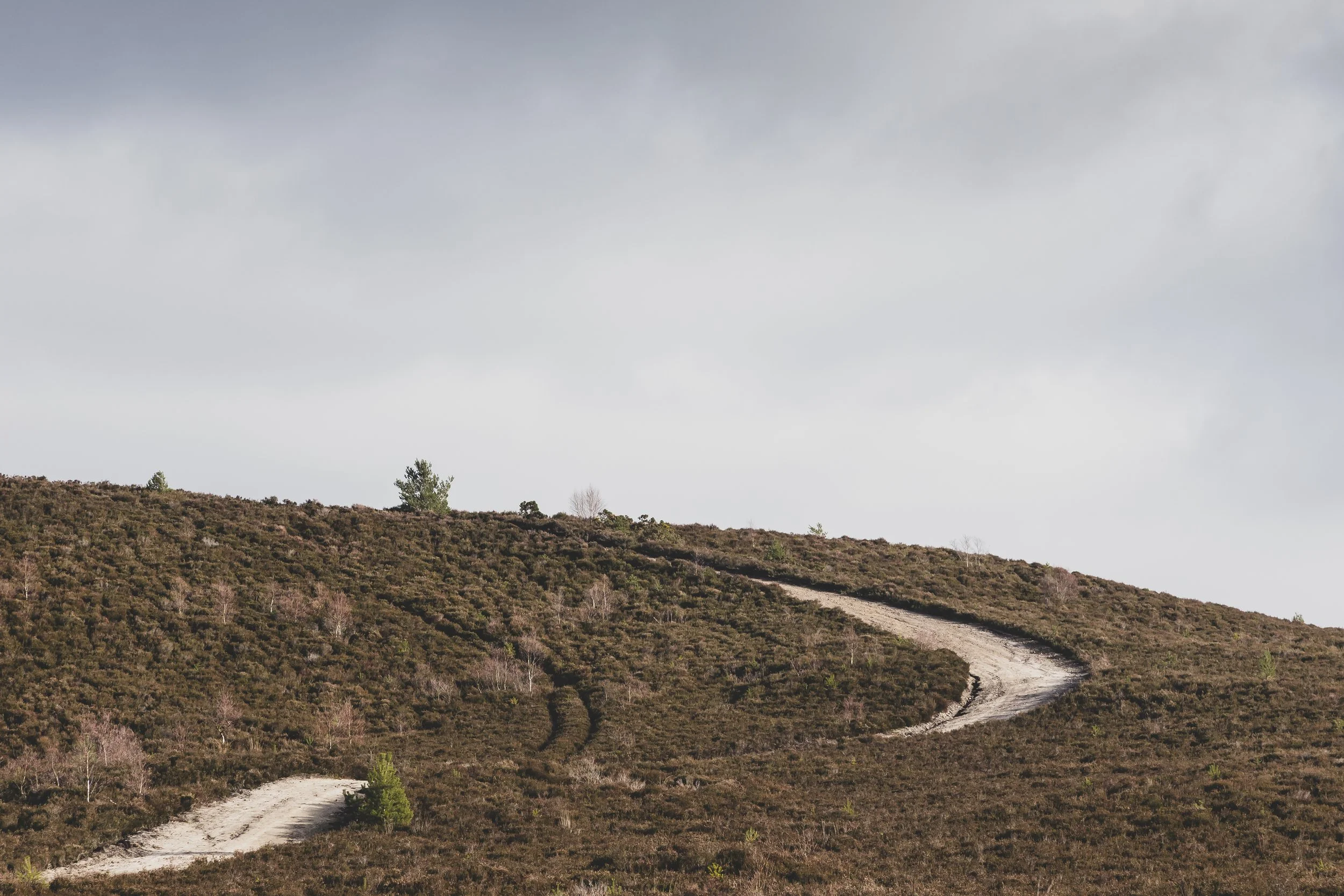
I remember it: that smell, the air. Sagebrush and dry juniper wood and a little bit of sandstone dust on the breeze. The intangible scent of wide-open space, the kind that makes a certain folk a little mad. The threat of snow in the distance and barley swaying like water in the wind. A hint of pine, if you searched for it, and the barest essence of granite. In the summers, cheatgrass and dry heat. Sweet clay dirt mixed with gravel and oak baked into a smear of cottonwoods and sugar beets.
I remember it all, sucked in on a single, slow breath.
I carry this place with me like a talisman, a deity of great solemnity tucked into the furthest pocket of my consciousness. Always there, though if I’m honest I only ever bother to pluck it out for examination when I’m far enough away to treat it like a strange, muddled memory.
In the cold, windy tunnels of the city, I sometimes close my eyes against the callous glare of the buildings and picture the roads I used to take to nothing, the soft farmland, lush green fields cast golden in the evening light, fading into the stony beauty of the high-desert plains. The dry brown limbs of mountain ash stretching and shifting into fell pine and high-altitude wildflowers—sharp and dry and consuming in color.
I recall the hum of truck tires on dirt roads, the way it sung in my bones. The cast of the sun, different on the boundless moors of home.
I don’t let myself recall it often. Memories are unpredictable creatures, prone to turning places into paradise only once you’ve left. I’m careful not to recall too fondly a place that no longer owns me.
But still, when the sun has set and the city turns over into glitter and cigarette smoke, and my downstairs neighbor begins pilfering through the recycling bin in the alley, cans crashing against old brick in a shout meant to waken—I let myself miss it. Just a little. If I squint.
The quiet. The lingering moment on the concrete front steps of the place I grew whole and then fractured again, when I pause for no reason at all—
—caught in the silence.
The near-forgotten breath of a cold winter morning—no engines, no horns, no steps, no rustle of coats no voices no doors opening and closing—not a soul in sight. Not even another breath aside from the one in my head, hushing in my eardrums. It’s a silence only just merciful enough to let the wind roam through the valley and the soft crack of pinecones catching against one another reach my ears.
I pause in that silence—
God, I had almost forgotten it, the sound of pine needles rustling, suspended against a glaucous sky. The slight howl of the wind through the valley in an attempt to voice the shape of the hills. I had almost forgotten what it felt like to sink into that quiet like a pebble at the bottom of a lake, cold, soothing water filtering into cracks. I imagine my gaze rising to the dark winter skies—I had almost forgotten the whole shape of that too;
An open sky.
The color of snow clouds, dark and light at once. The face of a soft winter morning sliced open by barren ash branches. A dry chill across your cheeks, the wind so cold you can almost see it. The way the cold winter morning should have made everything in sight frozen and still, but instead cast the world into a warmth unveiled only by contrast, a saturation reached only by emptiness.
I could recall wanting to reach out to that untouchable warmth, feel it in my limbs, but my fingers always remained numb and stiff.
I could not recall anywhere else that had quite that sort of frigid warmth. I knew, even then, that its beauty was dangerous. That I shouldn’t enjoy the cold for too long.
It is times like these, when the ache of home settles far more deeply into my skin than the snow-strewn wind, that I cannot quite tell if I love the place I came from or hate it. If I was made for this place—or made by this place. Without it, I am a sparrow lost in a vast, wind-strewn world. Without it, I am free to become anything I wish.
Even in the most distant reaches of my escape, I feel myself falling backward, toward the peaks of my childhood that rise like an island out of the prairie, their hematite faces slanting into juniper-clouded crests. I feel myself landing among the mountain-borne wildflowers who reign over the summits and the sandstone caves who guard the valleys.
This distinctive landscape grows sharper, brighter, truer in my mind with each year that passes, with each encroaching degree of discomfort. Occasionally, when I return, I recall that this place is real. That is does not live only in my mind. That I was here, once—in flesh. Part of the land. Evolving alongside the high plains flora into something both new and familiar.
And on my strangest days, I will admit that when I shed the gossamer cloak strung together by the distant places I’ve seen, I am really little more than a collection of moments spent roaming the limestone crevasses of these hills, climbing among hulking sagebrush bushes and unearthing gypsum left behind by the thin ancient sea that once covered this valley. I am at my least a reflection of this place of merging truths, an unending plain of history and continuance— seas and forests and deserts and homes of all natures swept into the exacting hands of history, mashed into a fair and unforgiving clay face. It is, at its heart, a place of life and death, always alternating between cracked-earth heat and frozen-tundra winters. Standing stoically at the crossroads of all the harshest conditions. It, for all intents and purposes, should have been uninhabitable. Inhospitable.
Nevertheless, unlikely life thrives. Perhaps this is what draws me back, all these years later. The core of me is just ten handfuls of days spent stumbling along behind my passionate and iron-willed father in a landscape I thought, at seven, might be the reincarnation of hell that our ancient Catholic priest had mentioned once or twice. It is sweat-stained baseball caps and mud-stiff sneakers. It is a dry plain of monotonous browns, rattlesnakes, and dirt fine enough to wiggle through any combination of sock and shoe. It is long days spent in the heat and an aching neck from combing the ground for treasure and threats alike.
And it is a place of history folded into timeless peaks. Of long-fingered wind and washed-out ravines riddled with fossils. Of flowers, delicate and hardy and found nowhere else on Earth. Of ice caves and the wildest, sternest variations of life.
It is my father, long arm stretched before my sisters and I, halting our steps across through the hills and over the washes.
“Here,” he says, stern face giving nothing away, but his dark eyes glittering. “Look.”
It is our small fingers eagerly digging through the soft, fine silt while my father waits patiently, casting a cooling shadow over us. He saw the treasure from ten paces away; he always had.
It is my older sister gasping in delight. “This?” She holds up a flat object with a sharp edge. Its smooth red surface winks in the sun.
It is the euphoric grin blooming under the desert sun on my father’s face.
“Do you know what this is?” he asks, gently taking the arrowhead and turning it over in his hands. We shake our heads.
“This is an artifact,” he says, letting us hover over the object in his hands. And then he tells us about the people to whom this land had always truly belonged; because they belonged to the land as well.
It is my father slowly, gently peeling back the history and the science of the world around us. It is him carefully handing us his own love for the place that fed his soul. Most days, I carry that love with me. Most days, I am sorry it is not enough for me to survive.
Before long, without meaning to, we came to know the shape of the land by heart. And it left its mark on us, as well. As the years passed and my sisters and I grew into creatures closer to the mountain thrush and the wild Spanish mares, a certain sort of curiosity began to take hold. A certain intractability.
Placed among the remnants of old seas and ancient places, we began to understand that there was much outside of ourselves. We began to think, in slow and subtle ways, about time, about temporality, about what it is to be thirsty and tired. We began to shift into less rigid beings, the crux of us drawn out by the silty breeze, by the catch of the cactus needles. We began to push back against the wind, to wander further than the land readily invited, unrepentantly curious about the world we had always known.
Unreservedly searching for more.
When we were old enough to truly understand what lay before us, what my parents had given us each time they dragged us out, grumbling, into the dry heat, or snow, or frigid wind, we extracted our own lessons from the land.
At some point, before I had decided to leave, I began to look for the delicate thrush building their nests in the prickly bitterbrush and proud ricegrass, for the horned lizards kicking up dust in their profligate rush to the next-nearest patch of shade.
In the undulations of the mountains, I began to see thousands of years of movement laid bare before me: an ode to a place crumpled by time and force, split open like misaligned joints, striking in its violent beauty.
But outside of the quiet thrum of the mountains, there was little waiting for me. And as much as I had become something akin to a creature of this land, I could not live among the lupine and swallows forever. This harsh landscape, I realized many years after I had left, was where I became something more than what I would have always been. It begged me to stay—and taught me enough that it forced me to leave.
Now, thousands of miles away and tucked neatly into the square edges of apartment buildings and city buses, I recall the brilliant ebony clay hillsides and melancholic call of the meadowlarks hidden in the rocky plains. I often reminisce about the sensation of soft limestone silt sifting through my hands, the sharp edge of a found arrowhead, the scent of cheatgrass and fine dirt kicked into the wind. My family has not left my reach in the same way the land has, but I miss the way we used to exist together there, too. Five curious animals in the shape of a family.
I close my eyes, occasionally, while I sit and listen to the hum of car engines and quick steps, and recall that quiet place. The way the wind sounds against the shape of the valley. The way my eyes relax against the endless miles of space laid bare before me. The sheer scale of it all. It lives with me still, as if it holds its own cognizance. It is this whispered language, not of words but of a near-forgotten rhetoric, of story and mystery, of evidence and impossibility, that I cannot quite seem to forget.
And sometimes I try not to let myself remember it at all. Sometimes I refuse to bow to the alpine hands that carved and cradled me, always at once brutal and nourishing. Sometimes I remember that I am no longer the shifting sandstone creature this place created, instead something closer to the vainly colored jasper, the swirling agate, the rigid limestone.
Even still, when I cannot quite feel the shape of myself, I return to the place where I am smallest. I pick myself out from the wide-open space, barely just a speck, and begin anew.
Sylvia Scianna
Sylvia Scianna is a writer and editor from the valleys of Montana. Her work often centers nature, feminism, and travel. She's currently earning her master's in publishing in Boston while she enjoys the city, helps run Redivider Literary Magazine, works for a medical journal, and writes her fantasy novel. Her work can also be found in Gnome and Bone Magazine and Chthonic Literary Journal. Follow her on instagram @i.biteand_i.write.
Quisque iaculis facilisis lacinia. Mauris euismod pellentesque tellus sit amet mollis.