Nonfiction
FALL 2026The Chain of Custody
by JEFFREY-MICHAEL KANE
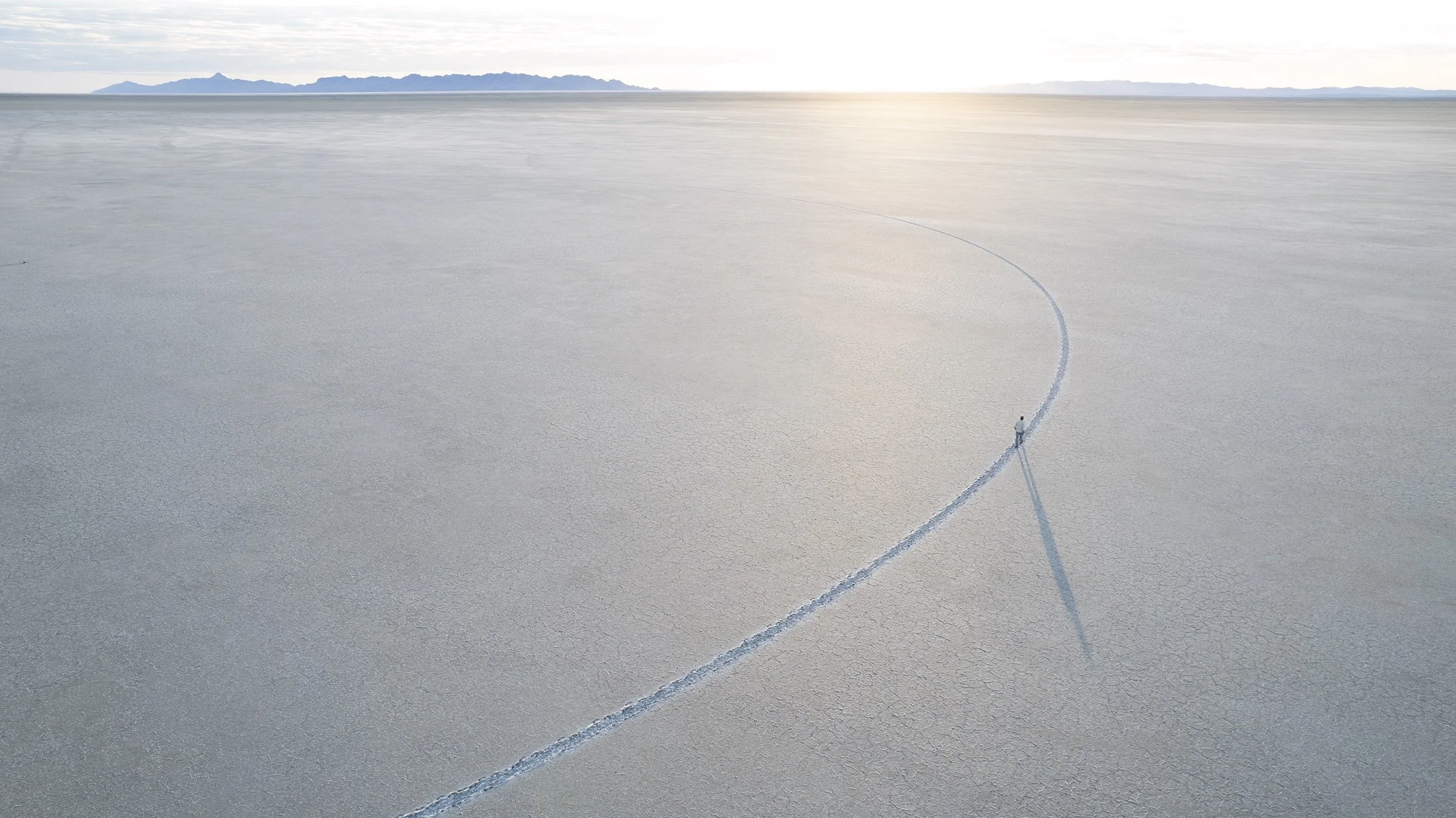
From A Circle Made by Walking by Michael Dax Iacovone
Aloof within the day’s enormous dome,
He holds unshared the silence of the sky.
Far down his bleak, relentless eyes descry
The eagle’s empire and the falcon’s home—
— George Sterling, “The Black Vulture,” 1911
*
At the south rim of the Grand Canyon, where the limestone terrace drops away into nearly two billion years of exposed stone, thirteen thousand people a day look up to find an empty sky. They are looking for nine feet of black wing. They have been told by the brochures at the Yavapai Geology Museum that this is the home of Gymnogyps californianus, the California condor—the largest land bird in North America, a Pleistocene relic that shared the canyon air with mastodons and giant ground sloths, an animal that does not flap so much as it negotiates with the thermal architecture of the desert.
When the shadow finally crosses the stone, it moves with the speed of a large, distant airplane. The bird does not look like a creature of the modern world; it looks like a geological feature that has found a way to detach itself from the cliffs. It rides the rising column of warm air with its primary feathers splayed like fingers, its naked head a dull orange wedge against the glare. The crowd at the rim behaves exactly like the crowd in the wooden hide at the Loch of the Lowes: it makes a low, collective sound—a sharp intake of breath at the sheer scale of the wildness, a recognition of something that appears entirely free of the human swarm.
Then the bird banks. The wing tilts sixty degrees toward the river, catching the hard afternoon light, and the illusion fails.
Fixed to the leading edge of the left wing—pierced directly through the patagium, the tough, fibrous membrane of skin between the shoulder and the wrist—is a heavy sheet of flexible, double-sided vinyl. It is a livestock ear-tag, the kind designed by the Allflex company to be punched into the ears of Herefords and Angus bulls to keep track of breeding cycles in a feedlot. This one is bright pink, numbered 54 in block, industrial typeface that can be read through a spotting scope from five hundred yards away. The pink plastic indicates the five-hundred series of the international condor studbook. The number 54 means this specific bird is Studbook Number 554, hatched in a sterile plywood brooder box at the San Diego Zoo Safari Park, sexed by a blood sample taken from its umbilical vein, and assigned a bureaucratic identity before its newborn down had even dried.
The sublime has been inventoried. The creature poet and playwright George Sterling watched above the Big Sur on the Santa Lucia coast in 1909—the one he described as holding “unshared the silence of the sky”—is now a numbered municipal utility. It owns the roads between the thunder and the sun only because an administrative coalition of federal biologists, private foundations, and zoo veterinarians follows it into the sky with GPS transmitters, walk-in traps, and clinical logs. To watch the condor honestly is to look past the ancient shadow and find the ledger beneath the wing.
*
Begin with the poem, because the poem is the baseline against which the modern inventory must be measured. In the Albert M. Bender Collection at the San Francisco Public Library, there is a 1909 typescript that represents the last moment the condor existed outside of management. It is titled, in George Sterling’s hand, “The California Condor.” In the margins, the critic Ambrose Bierce—a man who knew something about missing things—left pencil notes on the cadence.
Sunset magazine printed it in March 1910 as “The Condor”; only when he gathered the poem into his 1911 collection, The House of Orchids, did Sterling retitle it “The Black Vulture.” He wanted the bird to carry an abstract, gothic weight, but the physical animal he was watching was the wild condor population then making its last stand in the remote, roadless coast ranges of Ventura and Santa Barbara Counties. Sterling’s bird was defined by its distance from the human economy. It held “least of all the human swarm.” It was a sovereign that looked down upon the entire human apparatus with bleak, relentless, and contemptuous eyes.
The irony of the poem is that its fulfillment was exactly what Sterling thought impossible. He wrote that envious men were preparing to make “their dream and its fulfillment one,” predicting that human machines would eventually dare the bird’s roads between the thunder and the sun. He thought the airplane would violate the condor’s solitude. He did not foresee that the real violation would be much more intimate: that the human swarm would not just share the sky but would have to take physical possession of the bird’s blood, its skin, and its digestive tract just to keep its shadow falling on the ground.
By 1982, the world Sterling watched had collapsed into twenty-two birds. The wild population was dying so fast from lead poisoning and shooting that the U.S. Fish and Wildlife Service was forced to make an agonizing administrative choice: leave the birds to die with their dignity in the mountains or capture every single remaining condor on Earth and bring them into boxes. On Easter Sunday in 1987, an ornithologist named Jan Hamber watched through a spotting scope as a wild male known as AC-9 was lured into a cannon net in the Bitter Creek National Wildlife Refuge. When the net fired, the wild condor became an institutional asset. Others had gone in before him—one net, and then another, and then another, across two winters. This one only closed the account. For five years, there was not a single condor in the sky anywhere on the planet. The species existed only as a genetic portfolio split between San Diego and Los Angeles, its reproduction managed by computer programs designed to calculate the mean kinship coefficient of every possible mating pair.
*
The release site at the Vermilion Cliffs, a five-hour drive north of the canyon rim, is where this institutional portfolio is re-inserted into the geography. The landscape here is designed to look like the edge of the world. It is a thousand-foot wall of tiered Navajo sandstone that rises straight out of the red silt desert floor like a monument to isolation. The air smells of dry sage, parched clay, and the cold, metallic scent of the Colorado River deep inside Marble Canyon.
But at the top of the red rim, through binoculars, the infrastructure shows. Bolted directly into the sandstone face is the release pen—a massive cage of wood and heavy-gauge chain-link wire managed by The Peregrine Fund, a private conservation group that runs the Southwest recovery operation under a federal cooperative agreement. This is the staging ground where young birds, flown into Arizona from captive breeding facilities, spend months acclimating to the altitude before a biologist pulls a cable to open the wire door.
The man who manages this transition is Tim Hauck, the Condor Program Director for The Peregrine Fund. His job, and his field crew’s, is to run a wild landscape as if it were a high-care clinic. Every morning, the field crew loads the back of a four-wheel-drive truck with lead-free animal carcasses—mostly dairy calves salvaged from commercial operations—and hauls them out to specific feeding sites below the cliffs.
This is the second illusion of the condor story: the idea that these birds are hunting. A condor is an obligate scavenger; it requires the carcasses of large mammals to survive. In the Pleistocene, it fed on whales, seals, and mammoths; in the nineteenth century, it fed on the cattle herds of the Spanish ranchos. Today, the Southwest population lives on what is essentially a state-regulated, non-profit catering operation. The biologists do not leave the carcasses out of kindness; they leave them because the surrounding rangeland is a minefield of spent ammunition.
The arithmetic of the condor’s survival turns entirely on a single chemical element: lead. When a hunter shoots a deer or an elk with a standard lead bullet, the projectile does not remain intact. Upon impact with bone and muscle, it fragments into hundreds of tiny, microscopic shards that spray through the animal’s tissues up to eighteen inches from the wound channel. When the hunter guts the deer and leaves the slash pile on the mountain, the condors find it.
An unmanaged condor can read the landscape for food, but it cannot read it for isotopes. A piece of lead the size of a grain of sand is enough to kill it.
*
The pathology of lead poisoning is where the poetry of the bird is systematically dismantled by its anatomy. In a healthy condor, the digestive system is an engine of incredible power. The stomach acid has a pH of nearly 1—a concentration so intense that it allows the bird to dissolve rancid, bacteria-laden carrion, anthrax spores, and solid bones without falling ill. But this acid is the very thing that makes lead lethal. When a condor swallows a fragment of spent ammunition from a gut pile, the concentrated acid immediately begins to break down the solid metal, converting it into soluble lead ions that flood the bloodstream.
Lead is a neurotoxin. In the condor, its most immediate target is the autonomic nervous system that controls the smooth muscle of the digestive tract. The result is a clinical condition known as crop stasis.
The crop is the muscular pouch at the base of the bird’s esophagus where food is stored before moving into the gizzard. Under the influence of lead, the nerves governing this pouch die. The smooth muscle paralyzes. The crop becomes a dead, inelastic, sagging sack that cannot contract to push food forward. The meat inside stops moving; it sits in the warm, dark chamber of the neck and begins to putrefy. The bird’s blood is poisoned, its stomach is paralyzed, and it starves to death with five pounds of meat and offal rotting in its throat.
To prevent this, the management of the sky must become forensic. Twice a year, in the spring and the autumn, the field teams at the Vermilion Cliffs open the doors of the large walk-in traps. The condors, drawn by the smell of the clean calf carcasses inside, enter the pens. The doors drop.
What follows is an accounting of flesh. The biologists do not use the gentle phrasing of the tourist brochures; they use the language of the clinic. They pin the nine-foot wings against the body, place a hood over the bright orange head to reduce the bird’s heart rate, and pull the left leg out to expose the medial metatarsal vein. A technician inserts a needle, draws three drops of dark blood, and runs it immediately through a portable LeadCare analyzer sitting on a folding plastic table in the dirt.
If the machine reads less than ten micrograms per deciliter, the bird is clean. Its GPS transmitter—a small, solar-powered unit bolted to its tail feathers or wrapped around its patagium next to the vinyl tag—is checked for battery life. The vinyl ear-tag is inspected for wear. Then the bird is released back into the air.
If the blood chemistry shows more than twenty-five micrograms, the ledger enters the red. The bird is no longer an inhabitant of Arizona; it is a patient. It is crated, loaded into a truck, and driven down from the high desert to the Phoenix Zoo or the Los Angeles Zoo, where Dr. Kathy Orr or Dr. Dominique Keller takes custody of the asset.
The treatment for a lead-poisoned condor is an exhausting, industrial process called chelation therapy. The veterinarians place the bird under anesthesia and perform an esophagostomy—cutting a hole directly into the side of the neck to insert a temporary feeding stoma into the proventriculus, bypassing the paralyzed, rotten crop. Twice a day, for five-day cycles, they inject the bird with Calcium Disodium Edetate (CaNa₂EDTA) at a strict dosage of thirty-five milligrams per kilogram of body weight. These stoma-and-chelation protocols have been refined in tandem with Arizona avian specialists such as Dr. Stephanie Lamb, a board-certified bird veterinarian who has worked the recovery program’s severest crop-stasis and avian-influenza cases.
The chemistry of CaNa₂EDTA is a beautiful, cold piece of arithmetic. The molecule is a chelator—a molecular claw. It moves through the condor's bloodstream, searches for heavy metal ions, and strips the lead out of the bone marrow and soft tissue by wrapping around it. The calcium ion in the drug is replaced by the heavier lead ion, turning the toxic metal into a soluble, inert compound that the bird’s kidneys can filter out and pass into its excrement. If the bird has swallowed large, solid chunks of lead that cannot be dissolved by the chelator, the veterinarians must insert an endoscope down the throat and use surgical forceps to lift the metal fragments out of the gizzard one by one.
The cost of this operation is thousands of dollars per bird, paid for by private donations and public trust funds, carried out under federal permits that track every milligram of calcium disodium edetate injected into the population. The bird that Sterling described as “serene” above the broken tempest is kept aloft by a continuous loop of chemical scrubbing and manual gastric lavage.
*
Consider the Navajo Bridge, which spans the green ribbon of the Colorado River at the eastern entrance to the Grand Canyon. It is a historic twin-arch steel structure that carries tourists across the gorge. It is also one of the preferred perching sites for the Southwest condor population. On any given morning in July, the air under the bridge is cold, holding the scent of dry sandstone and river mud. From the pedestrian walkway, looking down into the steel superstructure, four or five condors sit on the iron rivets within inches of the concrete abutments.
They look like gargoyles. They sit completely still, waiting for the sun to heat the canyon walls and create the thermals they need to lift their heavy bodies. But as they preen their feathers, the bright vinyl tags on their wings swing like pendulums against the gray steel girders. A Pink 54, a White 87, a Blue 12. Every few minutes, a tourist with a smartphone leans over the rail, zooms in on the numbers, and types them into a public database managed by the National Park Service to find out the bird’s age, its lineage, and where it was hatched. The wild predator has been converted into a public interaction script.
Further north, inside Zion National Park, the geography becomes even more restrictive. Here, the project leader is Janice Stroud-Settles, a National Park Service wildlife biologist who manages the Utah sub-population. Her ledger is currently focused on an initiative to achieve sixty percent GPS transmitter saturation across the herd by 2027.
In Zion, the condors nest in the sheer, weeping-rock alcoves of the White Throne and Angels Landing. The visitors who hike the narrow, terrifying spine of Angels Landing believe they are sharing an experience with an ancient, unmediated wilderness. They do not see the seasonal technicians stationed on the opposite ridges with telemetry antennas raised to the sky, listening for the rhythmic beep-beep-beep of a mortality sensor. If a transmitter signal changes cadence—indicating that a bird has remained motionless for more than six hours—the technicians do not wait for nature to take its course. They use ropes, climbing harnesses, and rescue baskets to descend into the vertical sandstone slots, retrieve the carcass, and send it to the National Fish and Wildlife Forensics Laboratory in Ashland, Oregon, to determine if the death was caused by lead ammunition or the highly contagious H5N1 Highly Pathogenic Avian Influenza that tore through the flock in 2023.
The management is total. When the female of the condor mating pair lays an egg in a cave on the canyon wall, the biologists monitor the nest via long-range cameras. If the parents appear inexperienced or if the weather turns extreme, the field crew will climb into the nest, remove the real egg to an incubator in San Diego, replace it with a dummy plastic egg made of weighted polymer that mimics the exact thermal mass of a condor clutch, and then return the captive-hatched chick to the cave up to five or six weeks later and moments before it breaks the shell. The bird is born onto plastic, raised under surveillance, tagged at its first flight, and fed on salvaged calves until its blood turns to lead and its crop stops moving.
*
The accounts for the Southwest population close each year with a set of statistics published by the U.S. Fish and Wildlife Service. The report is called the California Condor Recovery Program Population Status. It is a ledger that counts every single individual alive on Earth, down to the very last one.
The report for the current cycle shows that the total global population sits at six hundred and seven birds, with more than three hundred and sixty of them flying free in the wild across California, Arizona, Utah, and Baja California. The numbers look like a triumph. They are a monument to what human ingenuity, dedication, and millions of dollars of veterinary infrastructure can achieve when an ecosystem has been broken by its own history.
But if you read the ledger past the totals, the balance sheet looks different. The data from the University of California, Santa Cruz Environmental Toxicology Division, which specializes in stable isotope fingerprinting, confirms that seventy to ninety percent of all wild condors tested show significant lead exposure each year. The isotope signature in the birds’ blood matches the chemical profile of commercial lead ammunition perfectly; it does not match the background lead levels of the desert soils or the regional geology. The birds are not recovering; they are being continuously laundered through a human processing system at the end of a sterile needle.
The thirteen thousand daily visitors to the rim drive home certain that they have seen Sterling’s bird—the aloof king, holding unshared the silence of the sky. What crossed the stone, though, was actually an asset that will not last thirty days without the intervention of humans. Nothing the condor owns is unshared any longer: the blood is drawn, the crop is bypassed, the kinship is reduced to a coefficient, the egg is swapped with a prosthetic, and the silence of the sky is airspace with a permit number. Sterling watched the horizon for the flying machine that would come for the bird from above. It came from inside instead, in a grain of lead—not unlikely one of the millions of rounds produced each day at a plant east of Little Rock they call Big Green, whose sign out front promises to conserve our heritage.
*
The nine-foot wing banks off the platforms and out toward the cold shadows of the inner gorge, where the river runs silent through the Vishnu schist. For a mile or two, past the last spotting scope, the pink tag vanishes against the dark rock, the numbers fade, and the studbook identity dissolves into the immense geometry of the stone. For three minutes the bird is exactly what Sterling saw—aloof, unshared, contemptuous of the swarm. Then it turns back toward the bridge and the next salvaged calf, and the three minutes end.
The ledger does not. It cannot be balanced, because the debt is the bird; it cannot be closed, because the morning the counting stops is the morning the entry dies. So each day it opens again from the top—every bird, every tag, every microgram—logging one more clean day against the sky.
Jeffrey-Michael Kane
J.M.C. Kane is the author of Quiet Brilliance: What Employers Miss About Neurodivergent Talent and How to Finally See It (CollectiveInk UK). His writing appears regularly in the North Carolina Literary Review and Wordgathering: A Journal of Disability Poetry and Literature. His essay “Nomenclature of a Life,” cataloguing his experience as a person with ASD-1, was awarded the 2026 Ellis Prize for Nonfiction from The New Ohio Review. He lives in New Orleans with his family where he works in humanitarian response.
Quisque iaculis facilisis lacinia. Mauris euismod pellentesque tellus sit amet mollis.