
Nonfiction
FALL 2026Rituals of Self-Verification: Narcissus with a Smartwatch
by CHRISTIAN DUARTE AND DAVID ANTOLINEZ
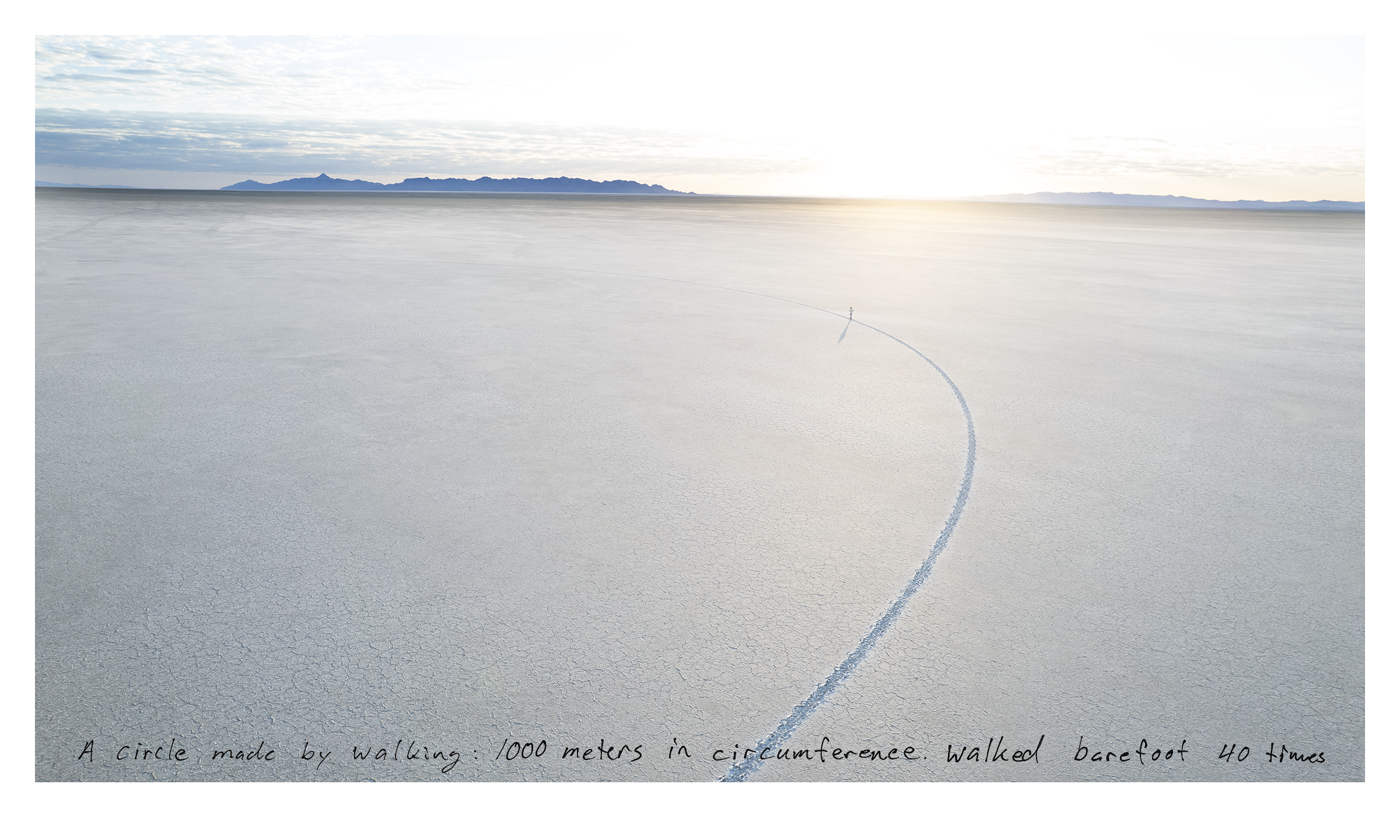
From A Circle Made by Walking by Michael Dax Iacovone.
A few months ago, half the internet seemed to organize itself around a rather depressing ceremony: uploading a photo of oneself and asking an AI model to return it “in the style of Ghibli.” For several days, social media filled with portraits of couples, pets, babies, landscapes, and breakfasts remade in that familiar blend of softness, nostalgia, and aesthetic tenderness associated with Hayao Miyazaki’s animated films. The whole thing had the feel of a harmless game, a visual fad, a collective whim. But it also revealed something less charming about our relationship to technology. We have been offered a tool capable of generating images of almost anything, and one of the first things millions of people chose to do with it was ask for more enchanting versions of their own faces. Narcissus, at least, had the decency to drown in the lake. We prefer to drain it so that we can admire our reflection in a better color palette.
One of the reasons Ghibli-style AI images became a news item was the material cost of producing them: water to cool data centers, electricity, servers, minerals, labor, and the whole physical infrastructure that the word cloud tries so hard to make disappear. Behind the charming portrait there are pipes, heat, cables, extraction, cooling systems, and waste. The fantasy of a digital world without friction rests on an extraordinarily material organization of matter and energy. If Narcissus once found his image in a surface of water, our reflections now require a machinery capable of boiling the planet. This AI imagery is not only a metaphor for contemporary narcissism; it is also a small scene of its metabolism.
What interests us, however, is not simply denouncing the ecological cost of these technologies or mocking those who spend an afternoon playing with their own “selfies.” What interests us is the kind of relation to the world condensed in gestures like these: the ease with which contemporary technology, even when it appears to offer access to the entire world, ends up being used to return us to ourselves. Google Maps allows us to wander through almost any corner of the planet, and one of the first things many of us do with Street View is look up our own houses. Our phones can photograph eclipses, fires, protests, birds, mountains, storms, and floods, yet much of their everyday labor consists in facilitating the endless circulation of our own faces. Smartwatches promise to help us understand our bodies, but often they end up converting sleep, walking, fatigue, and effort into a set of scores. The world is offered to us, and we answer with a question about ourselves.
This cannot be explained by vanity alone. Nor is it enough to say that we live in times of hyper-individualism, that capitalism rewards self-display, or that tech companies design their products to extract attention. All of that is true, but it does not quite exhaust the problem. Something more precise, more intimate, and more repetitive is taking place here: the proliferation of rituals of self-verification. Small ceremonies through which we repeatedly confirm that we exist in the proper way. Charging our watches before bed so that they can track our sleep. Waking up and checking how many times we moved during the night, how much deep sleep we got, what our lowest heart rate was. Going for a run and checking pace, elevation, effort zones, recovery time. Photographing a landscape before actually looking at it. Counting how many people reacted to our latest post on social media. Asking a machine to summarize, interpret, correct, or expand our own thoughts, then reading them back as if they came from elsewhere. These are not isolated gestures. They form a scattered but coherent liturgy, a mode of organizing attention in which the self becomes priest, believer, and object of worship all at once.
The word ritual is usually reserved for momentous events: baptisms, weddings, funerals, and seasonal festivals. But rituals also exist in far more modest practices. A ritual needs neither altar nor incense; it needs only repetition and meaningful intent—a sequence of actions that organizes time, distributes attention, and produces a certain relation between body and world. In that sense, contemporary life is saturated with small rituals: refreshing an app, checking notifications upon waking, charging a device before bed, photographing a meal, tracking a walk, closing one’s activity rings, asking an AI model to return a stylized version of a memory. These are ceremonies without declared transcendence, but they are not forceless. Like any liturgy, they redistribute value. They teach us what deserves to be contemplated, what counts as evidence, and what forms of experience seem incomplete unless they leave behind a shareable trace.
If there is one space where this logic becomes especially visible, it is in the entanglements among human bodies, landscapes, and self-tracking devices. Consider someone going for a run with a sports watch on their wrist. The scene is utterly ordinary: a person puts on running shoes, goes outside, breathes, sweats, comes home. And yet an entire interpretive apparatus has grown around that scene. The watch does not merely measure the distance covered. It also registers pulse, heart-rate variability, oxygen saturation, recovery time, sleep quality, training load, stress, available energy, pace on each segment, and comparison with previous efforts. The walk or run ceases to be merely a physical experience and becomes a production of data. A body not only feels; it becomes consult-able. The question is no longer simply How was the run? but What does the device say about it?
We understand the appeal of such a device. It would be absurd to pretend it has no use. For some people it can be genuinely helpful for training, pattern recognition, pacing, or health monitoring. The issue is not to oppose technology in the name of some primitive purity, as if there were a virginal and authentic way of walking through the woods waiting to be recovered. Our experiences of nature have never been innocent. They have always been mediated by language, class, transportation, culture, gender, history, and desire. Nor are we interested in the reactionary stance of condemning any tool simply because it is a tool. What intrigues us is the ease with which a technology designed to record certain bodily functions ends up reorganizing the meaning of bodily experience itself.
Henry David Thoreau, one of America’s great naturalists and promoter of civil disobedience, distrusted modern life enough to turn that suspicion into a unique style of thought. He once wrote about longing for “a walk that would take me not homeward, but to some point to which I had no intention of returning” (Thoreau, 1995/1862). The quote is part joke, part spiritual program. It does not mean that the walker must be permanently lost. Instead, it alludes to the possibility of movement that does not simply return us intact to our point of origin, a movement that does not reduce itself to confirming what we already are. For Thoreau, walking was not a strategy of self-optimization or wellness but a practice of exposure to the outside, a way of letting oneself be affected by an exteriority that disorients, tires, excites, irritates, and displaces. The forest and fields of Massachusetts, where the maverick poet used to dwell, were neither gyms nor fitness centers. Rather, they were places where the self stopped being a fixed point at the center of the frame, places where the self could start transformative experiences.
Thoreau’s understanding of walking was inseparable from his defense of wildness and from his apprehension of the routines of labor and civilization. “No wealth can buy the requisite leisure, freedom, and independence which are the capital in this profession,” he wrote of walking. Elsewhere, he mocked how a human body deforms under sedentary work, as though legs had somehow been made “to sit upon, and not to stand or walk upon.” Beyond his pastoral yearning, he refused to reduce life to productivity and calculation. For Thoreau, walking became a way of stepping outside the rationale that ordinarily claims our bodies: work, social performance, usefulness, efficiency, and measurable output.
Even if the pretense to alter our bodies is not at all new, the ease with which digital information presents itself as the most legitimate form of bodily knowledge is nothing short of unsettling. If the watch says we slept well, our fatigue becomes slightly less trustworthy. If the graph says the workout was productive, exhaustion acquires a different dignity. If one’s heart rate stayed in the right zone, the outing seems to count for more than if it had failed to produce a satisfactory metric. The data do not completely replace sensation, but they begin to compete with it for epistemic authority. Bodily experience becomes suspicious of itself. It is no longer enough to feel hunger, fatigue, pleasure, or pain; one must consult whether the device confirms that these sensations have been correctly interpreted.
There is a kind of vulgar phenomenology in all this that we find fascinating. A living human body does not dissect itself into a table of values. It presents itself as shortness of breath, tight muscles, sweat on the forehead, heat in the legs, a stitch in the side, heavy sleep, hunger, clumsiness, relief, dizziness, enthusiasm. None of these experiences can be reduced without remainder to a recovery score or a deep-sleep graph. Not because numbers are false but because they belong to a different regime of reality. They are partial translations designed for certain purposes. The problem begins when the translation disguises itself as privileged access to the inner truth of our corporeal existences. Our bodies, then, cease to be that liminal space between inside and outside we ought to learn to inhabit. Nowadays, they have become fields replete with information that must be extracted and quantified no matter the cost. Self-awareness degenerates into self-mining.
This movement toward quantification affects landscapes as well. Once a walk is organized around metrics, a forest risks becoming scenery for performance. It does not disappear, but it is subordinated. A mountain becomes a surface of elevation gain; a trail becomes an opportunity to improve a time; a lake becomes an attractive background for an Instagram story; a beach becomes a route on which to test a new watch; a sunrise becomes good lighting for demonstrating that one got up early to train. Even contemplation can become an accessory of the quantified self. One no longer goes into the mountains in order to get a little lost but to produce evidence that one was there in the correct way. Nature ceases to be an exteriority and becomes a stage for self-verification.
In his seminal essay Nature (1995/1836), Ralph Waldo Emerson—transcendentalist philosopher and close friend of Thoreau—insisted on the need for “an original relation to the universe.” The line is easy to sentimentalize, but what matters in this context is its hostility to second-hand experience. To know the world through ready-made mediations, inherited formulas, or prefabricated interpretations is to forfeit something essential in one’s encounter with it. Emerson’s take on solitude follows the same logic. “To go into solitude, a man needs to retire as much from his chamber as from society,” he writes; “if a man would be alone, let him look at the stars.” Solitude, in this sense, is not merely being physically isolated. It is a temporary release from the clutter of one’s own trivialities. It is the possibility of attention not entirely folded back upon the self.
Emerson helps us name what is lost when a (datafied) self becomes too dense, too central, too insistently present in every experience. If the point of being in the woods is ultimately to admire one’s own pulse, one’s own recovery score, one’s own image against the horizon, then one has not exactly gone into solitude; one has simply carried the chamber outward. Emerson’s famous line that “the sun illuminates only the eye of the man, but shines into the eye and the heart of the child” could be read as a reminder that attention can be something other than self-reference. A forest is not merely a better background for a self; it can also be a place where that self loosens its grip.
Gen-AI intensifies the reverse rationale in a particularly obscene way. If smartwatches already promise to tell us how our bodies are doing, AI takes it a step further and tells us how the world might look if it were slightly more on our sides. It takes a mediocre photograph and returns it smoother. It takes a vague thought and organizes it. It takes an insecure question and answers in the calm voice of someone who has a formulation always ready. It takes a memory and dresses it in the aesthetics of somebody else’s childhood. It is not surprising that such tools are seductive. They function as technologies of softening: reducing friction, smoothing rough edges, saving us the trouble of thinking or looking too long at something that displeases us. Their problem is that they not only simplify tasks; they also offer a form of interlocution that is extraordinarily compliant. One does not go to them in order to encounter a resistant alterity but to obtain a processed version of one’s own wishes. It’s “Mirror, mirror on the wall” all over again.
The Deleuzian language of escape and deterritorialization feels relevant here—even in an uncanny manner. In A Thousand Plateaus, French philosophers Gilles Deleuze and Félix Guattari describe “lines of flight” as movements that break with fixed arrangements, opening experience toward unexpected connections rather than returning it to already familiar coordinates (Deleuze & Guattari, 2004). Whatever one thinks of their vocabulary, it helps name the missed possibility at the heart of contemporary AI use. These systems could have functioned, at least in principle, as engines of estrangement—as machines for producing forms, worlds, and associations that exceed the already given. Instead, they are repeatedly folded back into a narcissistic circuit in which a self asks only to be returned in a more flattering form (Deleuze & Guattari, 2004). A technology that could have generated deviation becomes a mirror with better rendering.
The case of Ghibli-style images was especially revealing because it condensed several layers of this structure into one apparently tender gesture. The first was the desire to beautify the self: to see oneself as a character in a film, with warmer colors, gentler features, and a more benevolent atmosphere. The second was the appropriation of an aesthetic that, in its original context, served to imagine worlds inhabited by spirits, creatures, forests, and ruins but which in mass use became a way of passing banal scenes of private life through the filter of sweetness. The third, as discussed earlier, was the ecological cost of the process. The portrait did not come from nowhere. Behind each image were data centers consuming water and energy in order to sustain a trend whose underlying purpose was simply to ask the planet for yet another way to return our faces to us.
The obscenity of that scene is fascinating: a technology capable of generating unprecedented combinations of forms, impossible worlds, strange creatures, delirious landscapes, etc., and the decision of millions of users to employ it in order to re-portrait a dog, a boyfriend, a child, or themselves in a recognizable aesthetic. It is not that there is anything morally reprehensible about wanting a beautiful image. What is revealing is the scale of imaginative surrender. We are offered a machine of fiction and we respond with a request for confirmation. We are offered a machine of deviation and use it to return home. Something similar happens with Street View: a technology that allows visual movement across the planet ends up being used to inspect one’s own façade, one’s childhood home. The whole world is made available to vision, and our eyes use technology to close the circle of the self.
There is something legitimate in the curiosity of seeing oneself from outside, of checking whether the tree remains or whether the beloved bakery has disappeared. The problem is not the anecdote but the pattern. Again and again, technologies that promise to expand the horizon end up being used to reinforce the centrality of the subject. What consolidates itself is not only a culture of self-image but a form of attention in which the world appears valuable insofar as it can be returned as my experience, my data, my photograph, my version of memory. Alterity matters so long as it can serve as a reflective surface.
Let’s return to the ecological question, not as a moral appendix but as part of the very logic of the problem. The most disturbing thing about these rituals of self-verification is that they present themselves as intimate, almost immaterial experiences. Checking one’s sleep in an app feels private. Asking an AI to transform a photograph feels like a domestic game. Consulting Street View feels like idle drifting. Uploading a run to Strava feels like a small celebration of effort. None of these actions feels extractive in the moment. And yet all of them depend on complex material chains: minerals torn from the earth, factories, submarine cables, data centers, electrical consumption, cooling systems, e-waste, logistics, and labor. The liturgy of the digital self does not float above the world; it drills through it, heats it, drains it, and then conceals that cost behind friendly interfaces.
This is what makes a purely moral critique of narcissism so inadequate. The problem is not simply that some people are vain or that social media has made us self-absorbed. It is that a technical and economic order has turned self-observation into a profitable habit and sells it back to us as self-knowledge, health, creativity, or connection. Self-tracking culture does not merely ask us to display ourselves; it asks us to manage ourselves. AI does not merely ask us to play with images; it invites us to outsource portions of imagination, writing, search, and memory. Ecological crises then appear as side effects, unfortunate externalities, when in fact they belong to the same structure: we must extract ever more from the planet in order to sustain technologies that promise an ever more immediate relation to ourselves.
In The Question Concerning Technology (1977), the (in)famous German thinker Martin Heidegger argued that modern technology is not simply a collection of instruments but a mode of revealing that orders the world as standing reserve—as something on call, extractable, and available for use (Heidegger, 1958). Modern technology does not merely show us the world; it enframes it, to use a translation of Heidegger’s terminology, making beings appear primarily as resources. Read in that light, the smartwatch, the fitness dashboard, the AI portrait, and the quantified walk all begin to look like local versions of a much larger logic. A human body appears as a set of exploitable signals. Sleep appears as a resource to optimize. Attention appears as something to capture. Landscapes appear as scenery or training grounds. Even the self becomes a stockpile of data awaiting analysis. We do not merely instrumentalize the world; we learn to instrumentalize our own pulse, fatigue, and memory.
The smartwatch, therefore, feels like a perfect emblem of the present in that it condenses in one object several layers of contemporary reason: the promise of self-knowledge, the transformation of bodily experience into data, the conversion of exercise into performance metrics, and the relocation of authority from sensation to interface. Numbers on a screen are not corporeality. This is not to reject measurement; it is to resist the fantasy that measurement has exhausted experience. The point is not that data lie but that they are too easily mistaken for the truths of bodies themselves.
Thoreau, in this way, still feels enormously relevant for the suspicion he cast on the modern organization of attention. Walking, for him, involved ceasing to be so preoccupied with one’s own importance. It meant exposure to weather, fatigue, boredom, slowness, and disproportion between his own human body and the lands he traversed (Thoreau, 2021). Walking, for Thoreau, is undertaken not to purify oneself but to remember that a self is not the natural center of experience. In a world that constantly invites us back into ourselves, Thoreau’s idea of walking promises something almost scandalous: the possibility of a relation to the outside that does not immediately become performance, archive, content, or self-confirmation.
But the problem won’t be solved by leaving one’s phone at home. Capitalism is perfectly capable of selling us disconnection, retreat, mindfulness, silent hiking, and sunset contemplation as premium products. The fantasy of authenticity can easily become one more branch of the wellness industry. The point is not to oppose bad technology to good nature. It is to defend the need for experiences not wholly subordinated to demands to produce an image or a metric of ourselves, experiences in which our bodies are not merely projects to manage, landscapes are not merely proofs of a lifestyle, and time is not forced to justify itself by leaving an analyzable trace.
Perhaps that is what interests us most about the word ritual. It describes not just the ways contemporary culture organizes self-surveillance; it also allows us to imagine other repetitions, other liturgies, other ways of holding attention. There are rituals that fold the world back onto the self and rituals that, if only briefly, loosen that fold. Charging a watch to measure sleep is a ritual. Going for a walk without a goal or an app can also be a ritual. Turning a photograph into a Ghibli illustration is a ritual. Looking at a landscape without immediately photographing it can also be one. Checking one’s house on Street View is a ritual. Taking the long way home can be one too.
We are not proposing ascetic purity or a morality of sacrifice. We do not think the solution lies in renouncing every mediation or turning anti-technology into an identity. A more modest ambition would suffice: recovering a certain opacity. Allowing one’s body not to be exhausted by a quantifying dashboard. Allowing a walk not to become evidence. Allowing a memory not to require an embellished version of itself in order to deserve affection. Allowing a forest not to be merely the stage on which a watch certifies that we were alive efficiently. In short, defending zones of experience that do not immediately return to one’s self and that can, therefore, return something of the world to us.
It is worth inventing other rituals before there is no lake left for Narcissus’s followers in which to admire themselves and then drown. These need not be rituals of technological purification or ecological heroism. Small practices of decentering will serve very well. Walking without the obligation to produce data. Sleeping without expecting a quantified verdict in the morning. Looking at a landscape without immediately converting it into content. Using a machine, when necessary, without asking it to adore us. Remembering that imagination is good for more than retouching a family album. Remembering, finally, that the world is not an interface built to return our faces to us, or that if it insists on doing so, we might step aside a little from those persistent reflections.
References
Deleuze, G. & Guattari, F. (1987). A Thousand Plateaus. University of Minnesota Press.
Emerson, R.W. (1995). Nature (originally published in 1836). Penguin Books.
Heidegger, M. (1977). The Question Concerning Technology and Other Essays. Harper Torchbooks.
Thoreau, H.D. (1995). Walking (originally published in 1862). Penguin Books.
Christian Duarte and David Antolinez
Christian Javier Duarte Parra is a Colombian clinical psychologist and philosopher whose work brings together psychology, phenomenology, and philosophy of mind. He holds a Master’s degree in Clinical Psychology and a Master’s degree in Philosophy from the Universidad Nacional de Colombia. His research explores the nature of subjective experience, altered states of consciousness, personality and character change, addiction, and the relationship between bodily and psychological experience. His recent work examines the potential of phenomenological approaches for understanding transformative experiences, including those associated with MDMA, while his broader interdisciplinary interests include clinical psychology, palliative care, psycho-oncology, and philosophy applied to psychological questions.
David Antolínez Uribe is a psychologist and independent researcher whose work explores the intersections of philosophy, psychology, anthropology, and science and technology Studies. He holds a degree in Psychology from Pontificia Universidad Javeriana in Colombia and a Master’s degree in Human Sciences from the Universidad de la República in Uruguay. His research focuses particularly on the philosophy of Bruno Latour, ontological pluralism, modern dualisms, and the philosophical foundations of psychology and the social sciences. His recent publications examine topics including the ontological turn, Cartesian dualism, psychoanalysis, and contemporary debates surrounding science, technology, and society.
Quisque iaculis facilisis lacinia. Mauris euismod pellentesque tellus sit amet mollis.